
The numbers tell the story: companies waste an average of 9.2 hours per contract on manual processes, and 71% of businesses admit they are unaware of the actual contents of their contracts. For in-house teams managing enterprise-wide agreements, this chaos can be hugely frustrating.
Fortunately, there’s a way out.
A good contract management software can change this narrative. However, not all CLM tools solve the same problem. Some are ideal for storing contracts, others streamline intake and automate workflow, and some work best for documentation, and so on.
In most cases, legal teams may need several. For example, a team can use a CLM for contract execution and a legal intake platform to manage requests.
But here's the challenge: with dozens of contract management solutions flooding the market, each promising to be the "ultimate" platform, how do you choose the one that actually fits your in-house team's needs?
This guide cuts through the noise. We've evaluated the leading solutions based on what actually matters to in-house legal teams: setup time, AI capabilities, workflow automation, integration ecosystem, and whether the tool turns Legal into a strategic partner and not just a faster contract processor.
Key Takeaways
- Traditional CLM software focuses on contract execution, while legal intake platforms manage the broader request workflow.
- The best CLM solution depends on the team's primary pain points.
- AI-powered tools can reduce contract review time by 50% or more.
- Purpose-built legal tools generally outperform generic workflow platforms, like Jira or ServiceNow, for in-house legal teams.
- Streamline AI excels in legal intake automation and matter management, integrating seamlessly with CLMs like Ironclad to create a complete legal operations stack.
Best Legal Contract Management Software
After extensive research and analysis of the leading platforms, we've identified the 11 best legal contract management software solutions suited for in-house legal teams in 2026.
1. Streamline AI: Best for Legal Intake & Workflow Automation
Streamline AI takes a different approach to the contract management problem. Instead of starting with the contract repository, it begins where your contracts actually start: the chaotic flood of requests that hit your inbox, Slack, and Teams channels every day.
Built by a former AGC at DoorDash, Streamline AI emerged from a real operational challenge. During DoorDash's explosive growth, the company faced an avalanche of legal requests with no scalable way to manage them.
Generic task management tools aren't built for legal work, and traditional CLMs only assist once a request has become an actual contract, leaving the messy intake and triage process completely unmanaged.
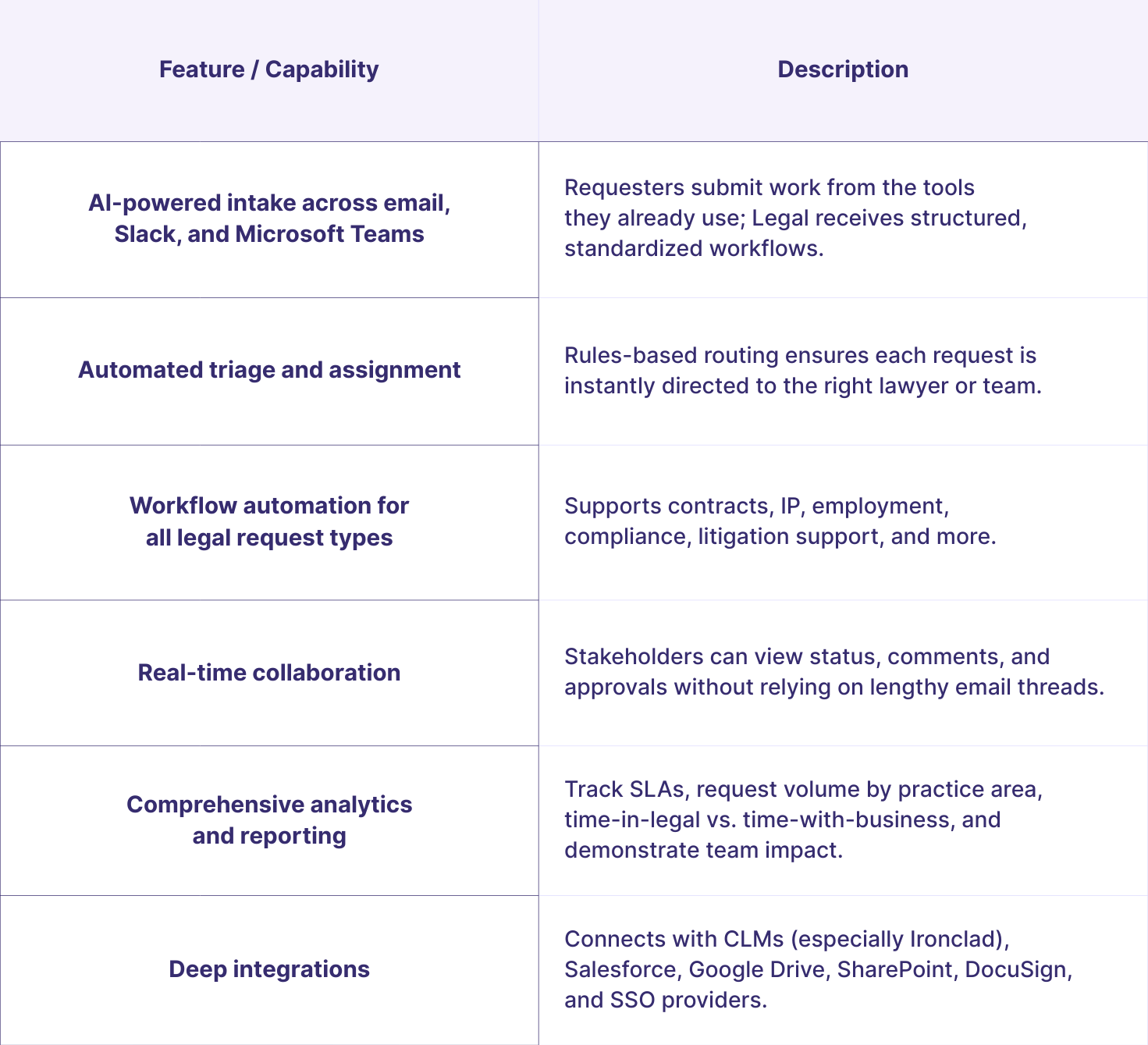
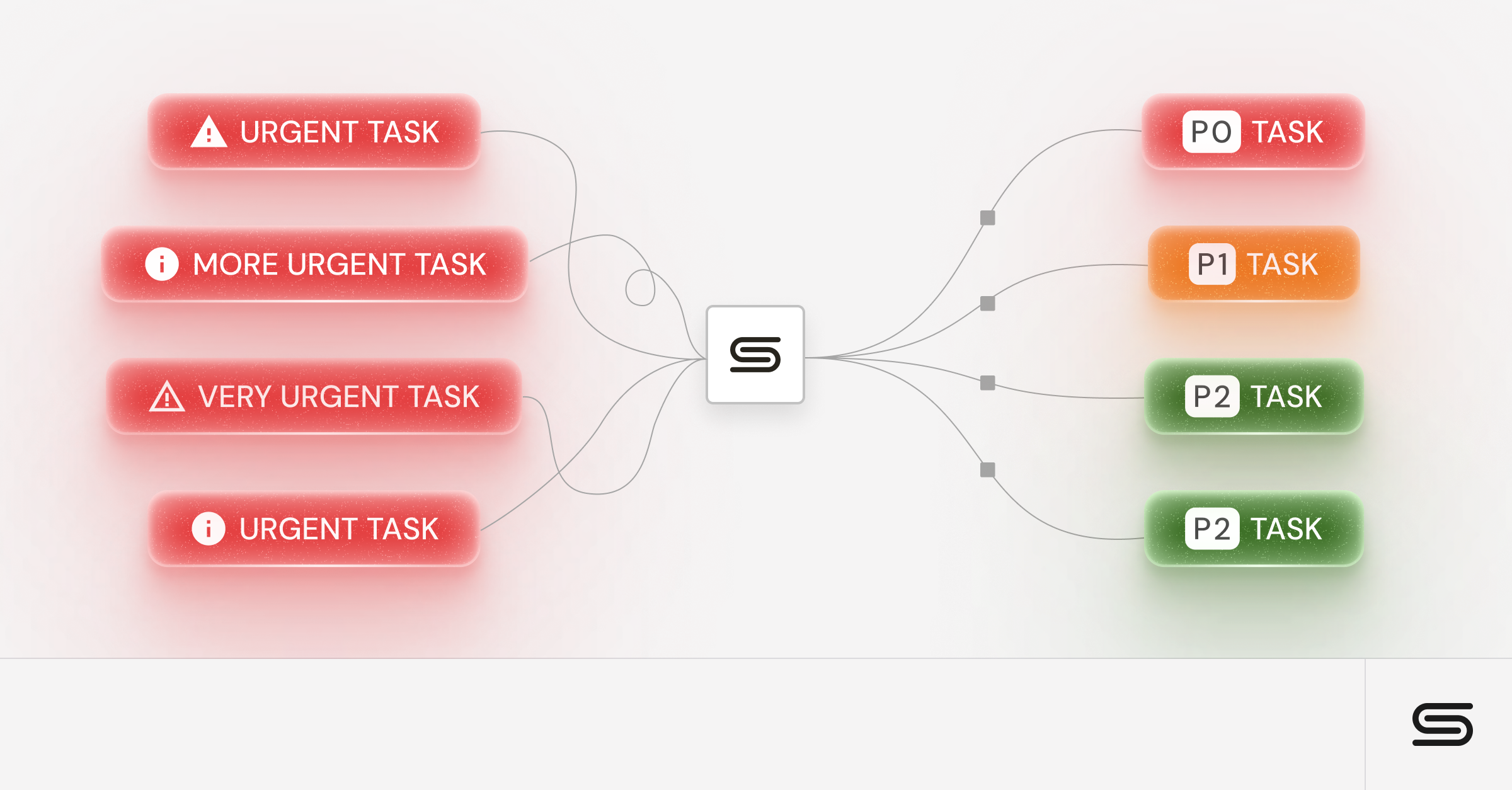
Streamline AI focuses on the entire legal request lifecycle, not just contracts. It allows you to handle vendor reviews, employment questions, compliance requests, and NDAs all in one platform. The AI-powered email intake automatically reads unstructured requests and converts them into structured workflows.
Streamline AI Core Features
Benefits of Streamline AI
Here are some benefits of using Streamline AI:
Eliminates the "Bottleneck" Perception
Numbers don’t lie. When you can show executives exactly how and where the ball is in play, you control the narrative. Streamline AI's analytics reveal where requests take longer, providing you with the ammunition to push for fair resource allocation.
Case Study - Apollo: Apollo's legal team cut request processing times by over 50% in just 4 months after launching Streamline AI's intuitive, no-code platform. This huge improvement helped them demonstrate that Legal wasn't the bottleneck; the data showed exactly where delays actually occurred.
Reduces Legal Burnout Through Intelligent Automation
Burnout isn't just about volume; it's about the soul-crushing work of chasing down requesters, re-explaining your intake process, and manually routing everything. Streamline AI automates tedious tasks, allowing lawyers to focus on substantive legal work.
Automated reminders, approval routing, and status updates enable the team to stop being administrative coordinators and start being strategic advisors. The platform handles the project management; you handle the legal expertise.
Case Study - 8x8: 8x8's legal team cut initial request handling by 30-60 minutes per request and improved workflow efficiency across teams. By eliminating the repetitive administrative work of gathering information and chasing stakeholders, lawyers reclaimed hours each week for meaningful legal work.
Scales Without Adding Headcount
Fast-growing companies face a harsh reality: the volume of legal requests can grow faster than their budgets can support. Streamline AI customers typically handle 30-50% more requests with the same team size after implementation. This way, the platform becomes a force multiplier.
Case Study - Favor Delivery: Favor Delivery's legal team achieved sub-48-hour response times and enhanced collaboration across the business with Streamline AI. As the company scaled, the legal team maintained fast turnaround times without hiring more staff.
Sets Up in Weeks, Not Months
Streamline AI's intuitive design enables legal teams to configure workflows independently, eliminating the need for IT involvement. The platform adapts to your existing processes rather than forcing you to rebuild everything around a rigid system.
Drives Cost Reduction Through Better Resource Allocation
When you can see exactly where outside counsel spend occurs and identify patterns in requests, you make smarter decisions about what to handle in-house versus outsource. This data-driven approach to resource allocation delivers immediate ROI.
Case Study - Cityblock Health: Cityblock Health cut outsourced legal OpEx by 40% by optimizing resource allocation and enhancing collaboration with Streamline AI. The platform's analytics revealed exactly which types of matters were being sent to outside counsel unnecessarily, enabling the team to strategically bring more work in-house.
How to Get Started with Streamline AI
Implementation begins with a discovery call, during which Streamline AI's team learns about your current processes, pain points, and goals. You'll see a customized demo that shows how your workflows would function on the platform.
After contracting, the customer success team provides white-glove onboarding, building your intake forms, configuring automation rules, setting up integrations, and training your team.
The platform is designed for legal professionals, not IT teams. You control your workflows and can adjust them as your processes evolve. No tickets to IT, no waiting for vendor updates; just the flexibility to run Legal the way you need to.
Book a demo to see how in-house legal teams are transforming chaos into clarity while cutting request resolution times by 50% or more.
2. Ironclad: Best Enterprise CLM Platform
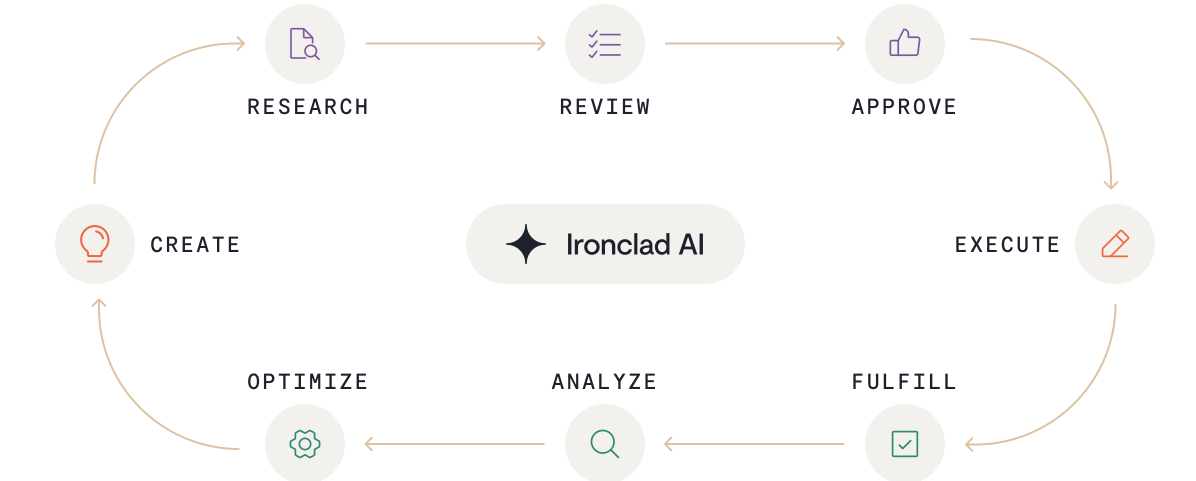
Ironclad built its reputation as the CLM for high-growth tech companies and has matured into a full-featured enterprise platform. If your primary need is contract execution (drafting, negotiating, approving, and signing contracts at scale), consider Ironclad.
The platform excels at turning contracting into a streamlined, repeatable process. Self-service workflows enable business users to generate NDAs and simple agreements without involving Legal.
Ironclad Workflow Designer gives legal teams granular control over approval chains, redlining permissions, and exception handling. The contract repository provides a searchable system of record with clause-level visibility.
Core Features
- Contract workflow automation with self-service capabilities
- AI-assisted contract redlining and clause extraction
- Centralized repository with advanced search
- Approval routing and digital signature integration
- Salesforce integration for contract lifecycle tracking
- Robust reporting and analytics
Pros and Cons of Ironclad
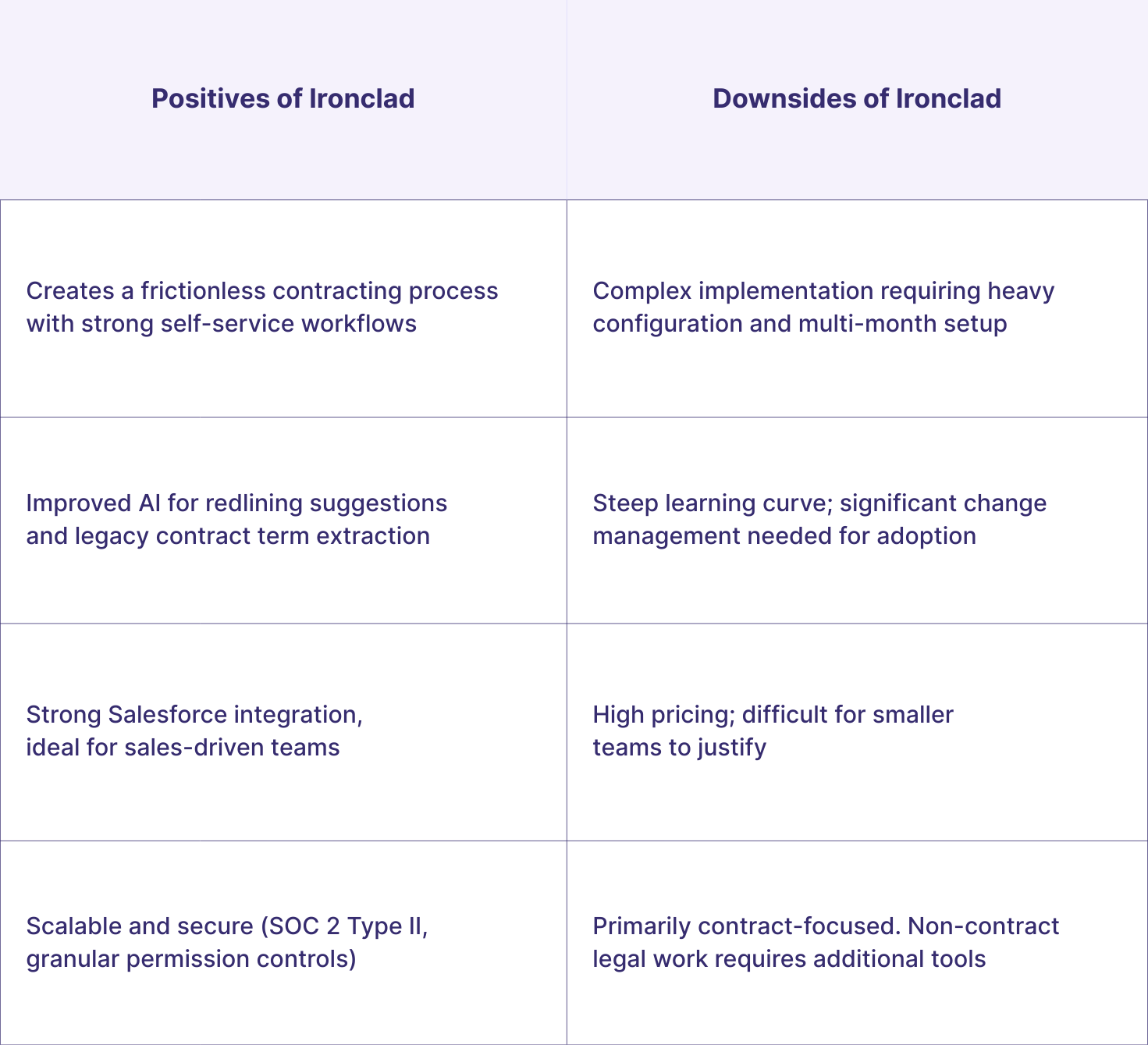
The Ironclad + Streamline AI combination is powerful. Use Ironclad for contract execution and Streamline AI for intake, triage, and non-contract legal work. This integrated approach solves problems neither tool can address alone.
3. Docusign CLM: Best for E-Signature Integration
If your organization already uses Docusign for e-signatures, Docusign CLM is a logical extension. The platform offers comprehensive contract lifecycle management, featuring seamless integration with signature workflows and eliminating awkward handoffs between systems.
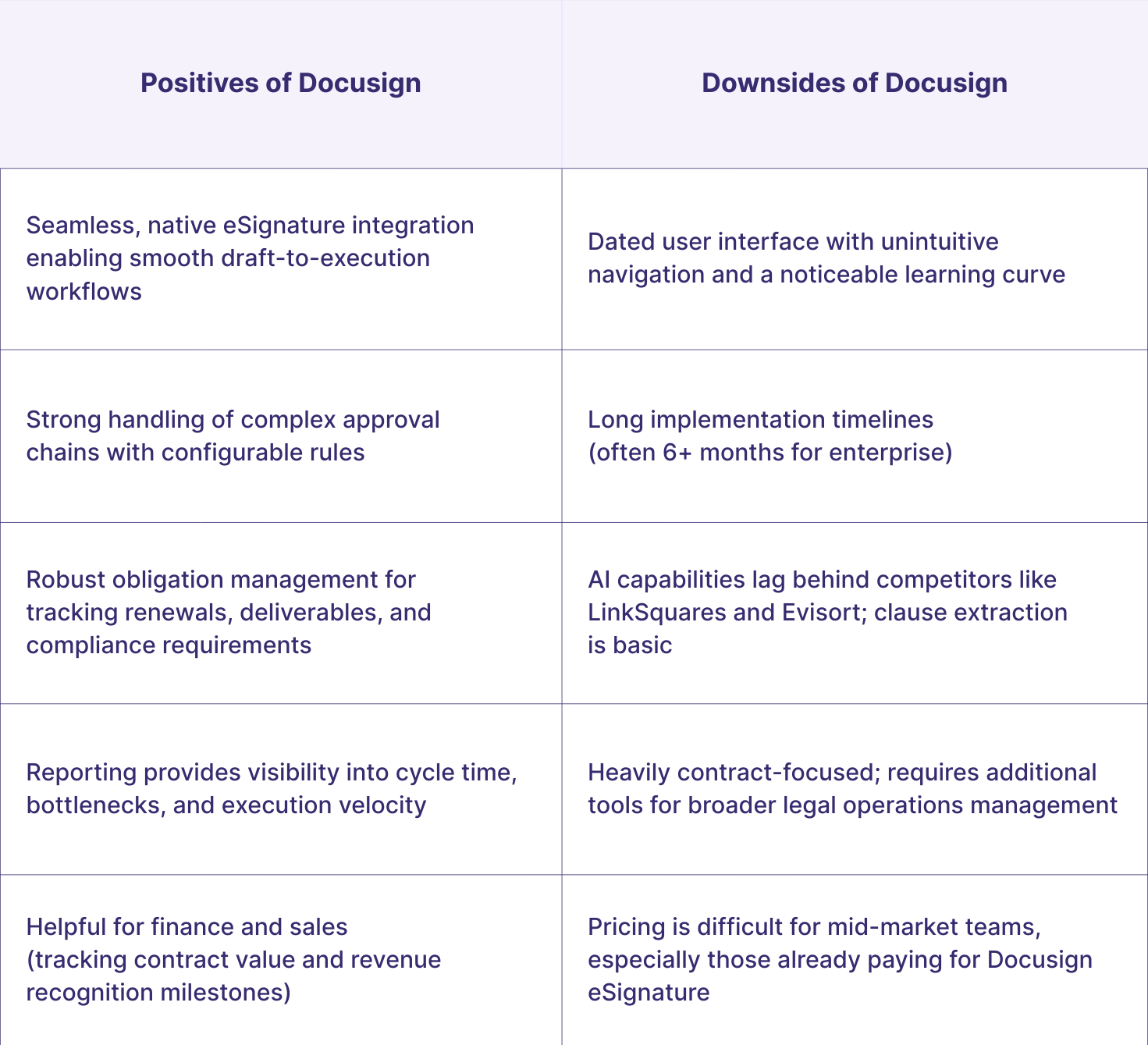
Docusign CLM evolved from the SpringCM acquisition, and it shows. The platform is mature, with enterprise-grade features for contract generation, negotiation, obligation management, and reporting. The native integration with Docusign eSignature is genuinely smooth, eliminating the friction of moving contracts between separate platforms.
Core Features
- Contract generation from approved templates
- Collaboration tools for negotiation and redlining
- Obligation and milestone tracking
- Native Docusign eSignature integration
- Salesforce and Microsoft Dynamics integration
- Configurable approval workflows
Pros and Cons of Docusign
4. LinkSquares: Best AI-Powered Contract Analytics
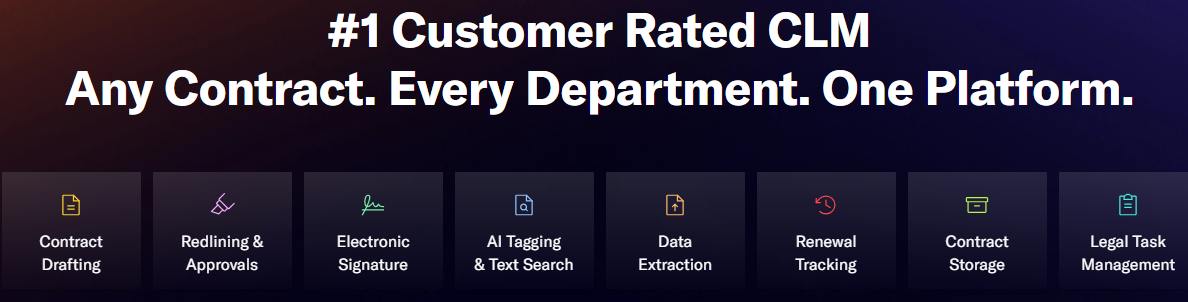
LinkSquares distinguished itself early with AI-powered contract analytics, and the company has continued investing in machine learning capabilities. If your primary goal is extracting intelligence from existing contracts or analyzing third-party documents, LinkSquares is worth considering.
The platform's AI reads contracts and extracts key terms, obligations, dates, and financial information. This creates searchable contract metadata without manual data entry, a significant advantage when migrating from spreadsheets or legacy repositories.
LinkSquares Analyze helps legal teams answer questions like "Which contracts have automatic renewal clauses?" or "When do our data processing agreements come up for renewal?"
Core Features
- AI-powered contract analysis and data extraction
- Contract repository with advanced search
- Workflow automation for contract lifecycle
- Obligation and renewal tracking
- Microsoft Word and Salesforce integration
- Reporting and analytics dashboard
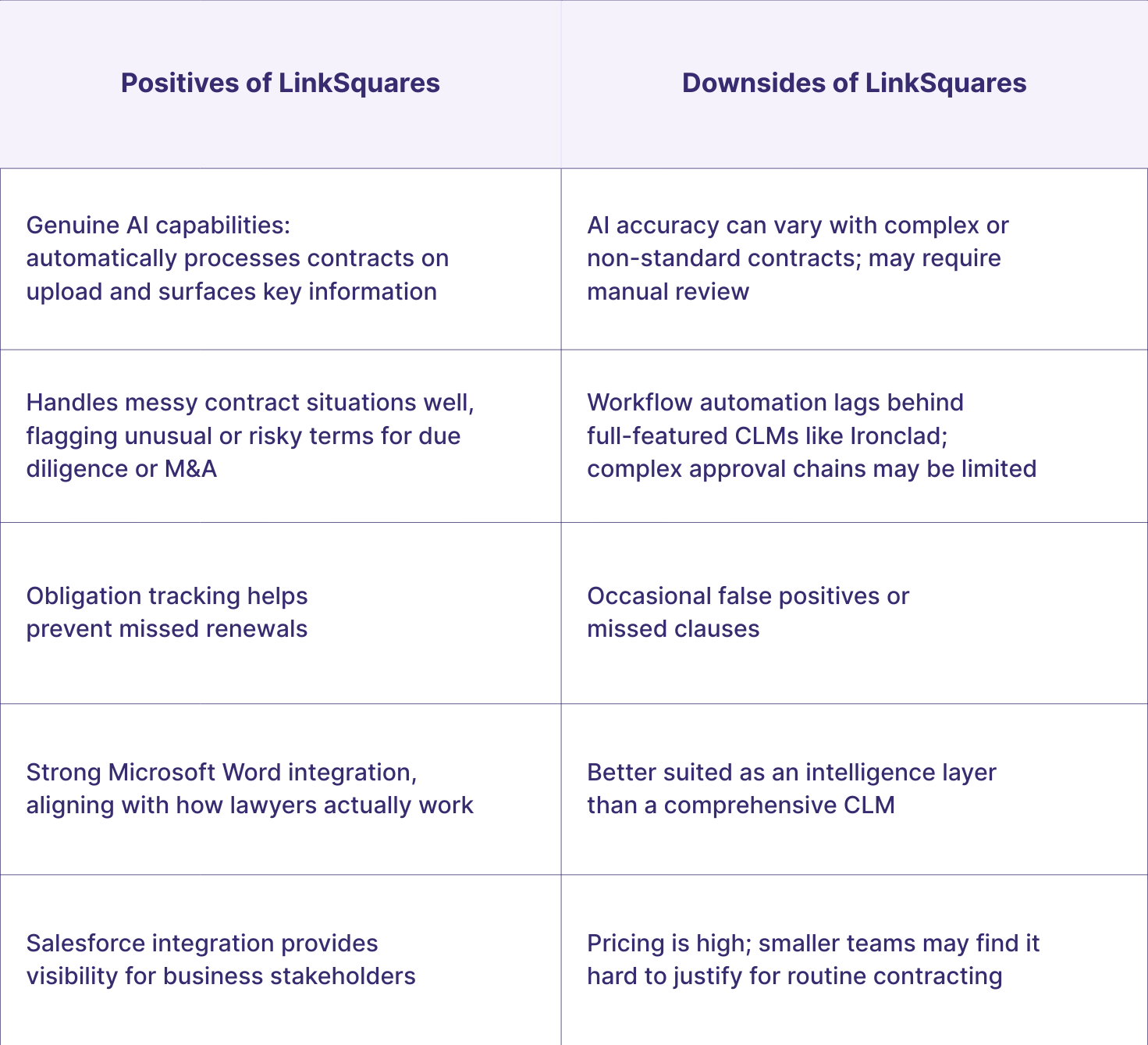
Pros and Cons of LinkSquares
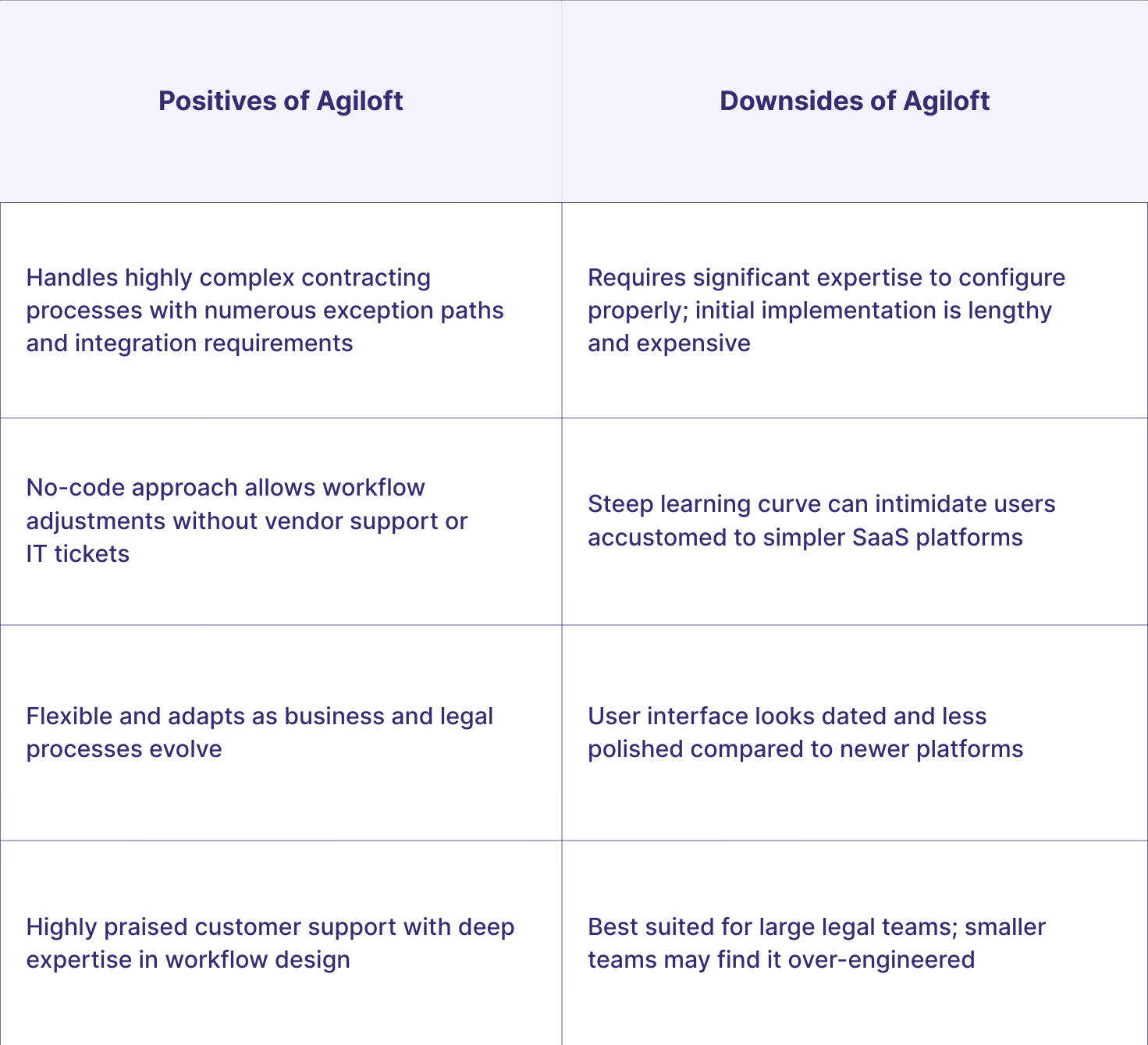
5. Agiloft: Best for Complex Workflows

Agiloft has earned its reputation by handling workflows that other CLM platforms struggle to manage. If your contracting process involves multiple departments, complex approval chains, and detailed exception handling, Agiloft's configurability becomes a competitive advantage.
The platform is a no-code workflow engine tailored for contract lifecycle management. Everything is customizable, including fields, forms, workflows, notifications, and integrations. This flexibility enables legal teams to model their work processes, rather than adapting to a vendor's opinionated approach.
Core Features
- Highly configurable workflow designer
- Contract generation from templates
- Advanced approval routing and escalation
- Obligation management and reporting
- Extensive integration options via API
- Multi-language and multi-currency support
Pros and Cons of Agiloft
6. Icertis: Best for Enterprise Procurement
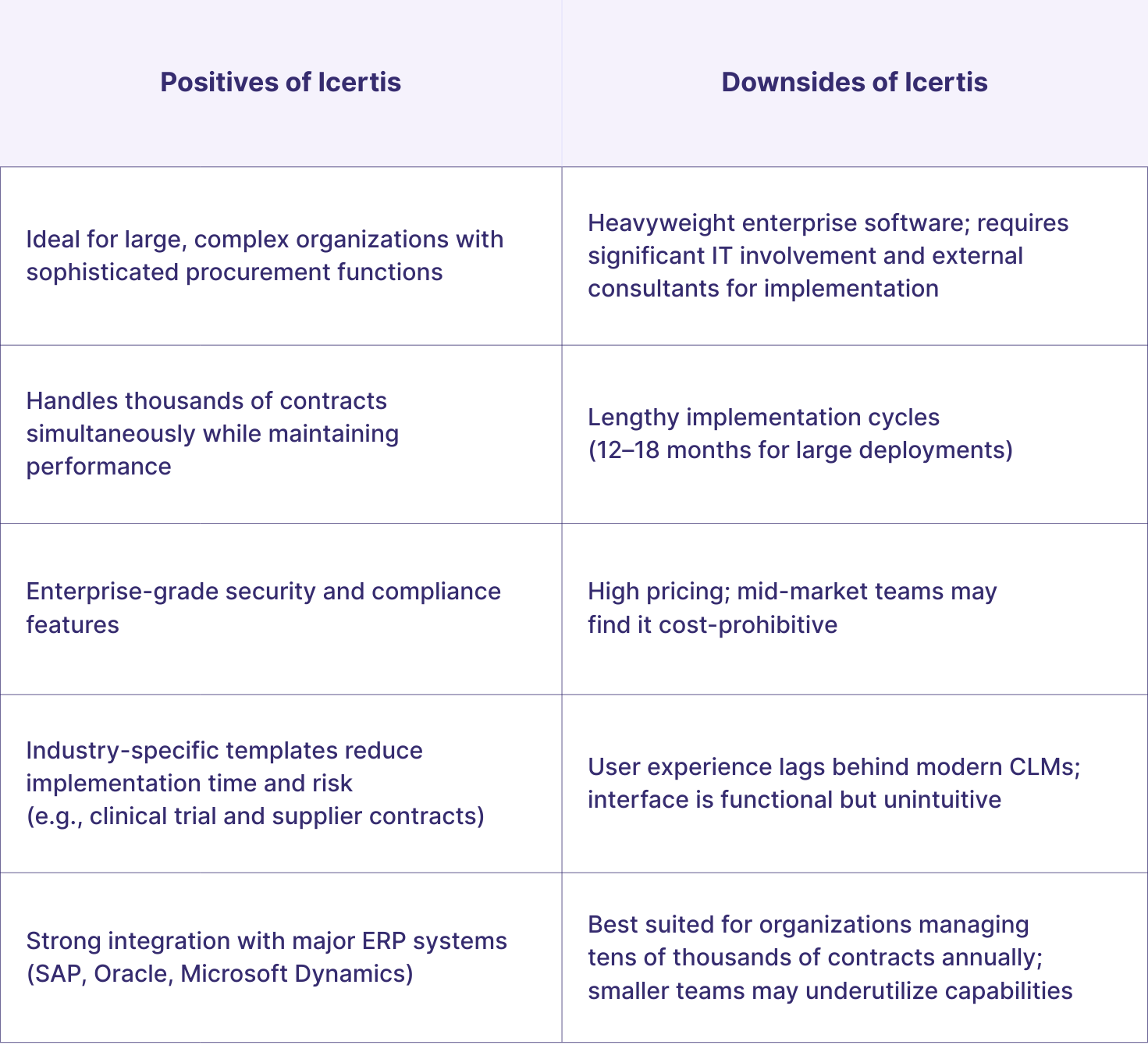
Icertis targets large enterprises with complex procurement needs, particularly those in regulated industries. The platform manages supplier contracts, master services agreements, and procurement workflows on a massive scale.
The strength of Icertis lies in its enterprise-grade architecture and industry-specific contract templates. The platform includes pre-built workflows for manufacturing, life sciences, financial services, and other heavily regulated sectors.
Compliance features, such as audit trails, risk scoring, and regulatory clause tracking, address enterprise requirements that general-purpose CLM tools often overlook.
Core Features
- Enterprise-grade contract repository and search
- Industry-specific templates and workflows
- Supplier and vendor contract management
- Risk and compliance scoring
- Integration with ERP and procurement systems
- Advanced analytics and reporting
Pros and Cons of Icertis
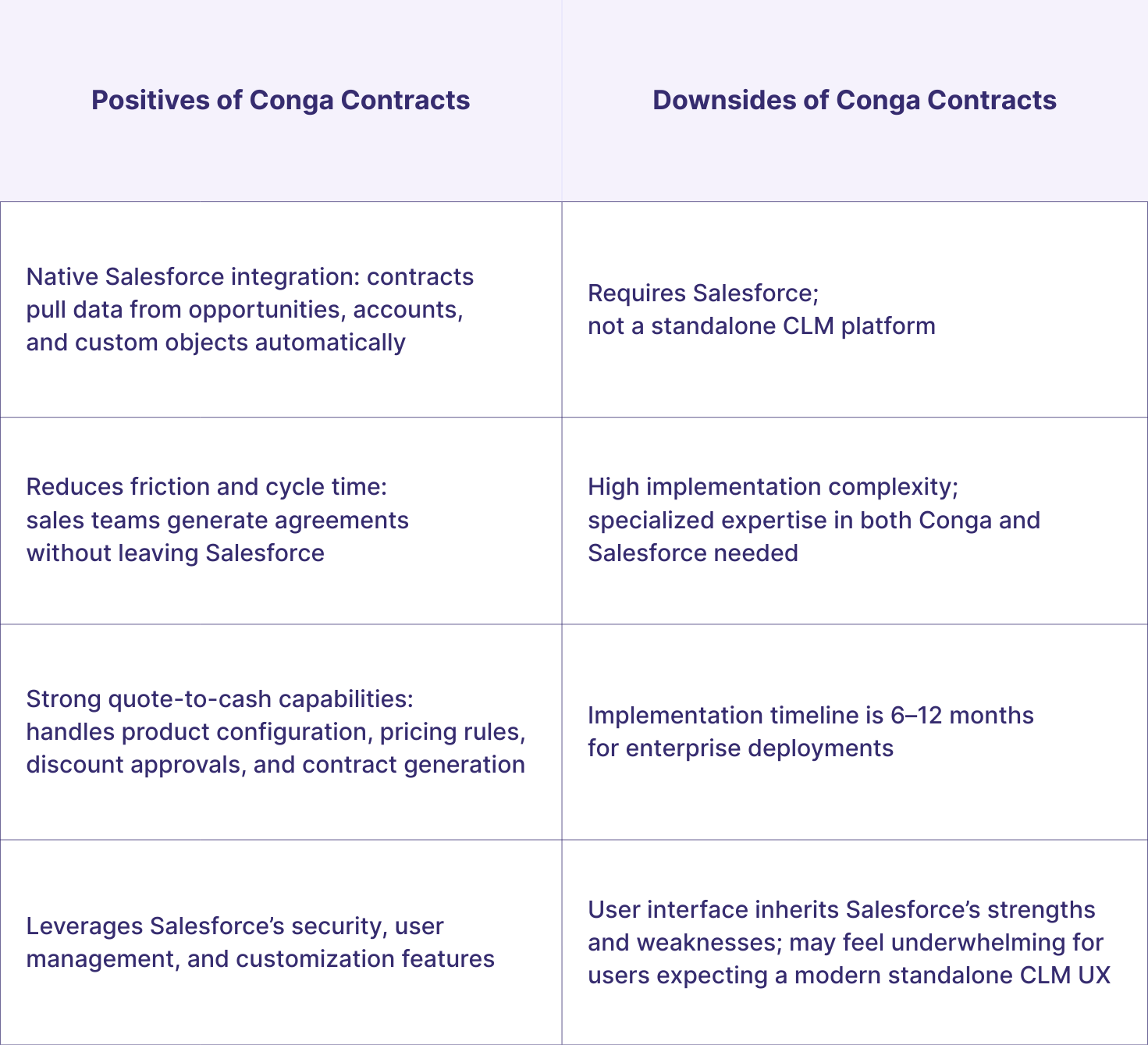
7. Conga Contracts: Best for Salesforce Users
Conga Contracts (formerly Apttus) built its platform natively on Salesforce, making it a natural fit for organizations heavily invested in the Salesforce ecosystem. If your company runs on Salesforce and wants contract management tightly integrated with CRM, Conga is worth considering.
The native Salesforce architecture means contracts live where your sales and customer data already exist. No separate login, no data synchronization issues, no integration complexity. For Salesforce-centric organizations, this seamless experience creates real operational advantages.
Core Features
- Native Salesforce CLM platform
- Quote-to-cash automation
- Contract generation from Salesforce data
- Approval workflows within Salesforce
- Obligation and renewal tracking
- Document generation and e-signature
Pros and Cons of Conga Contracts
8. ContractWorks: Best Budget-Friendly Option
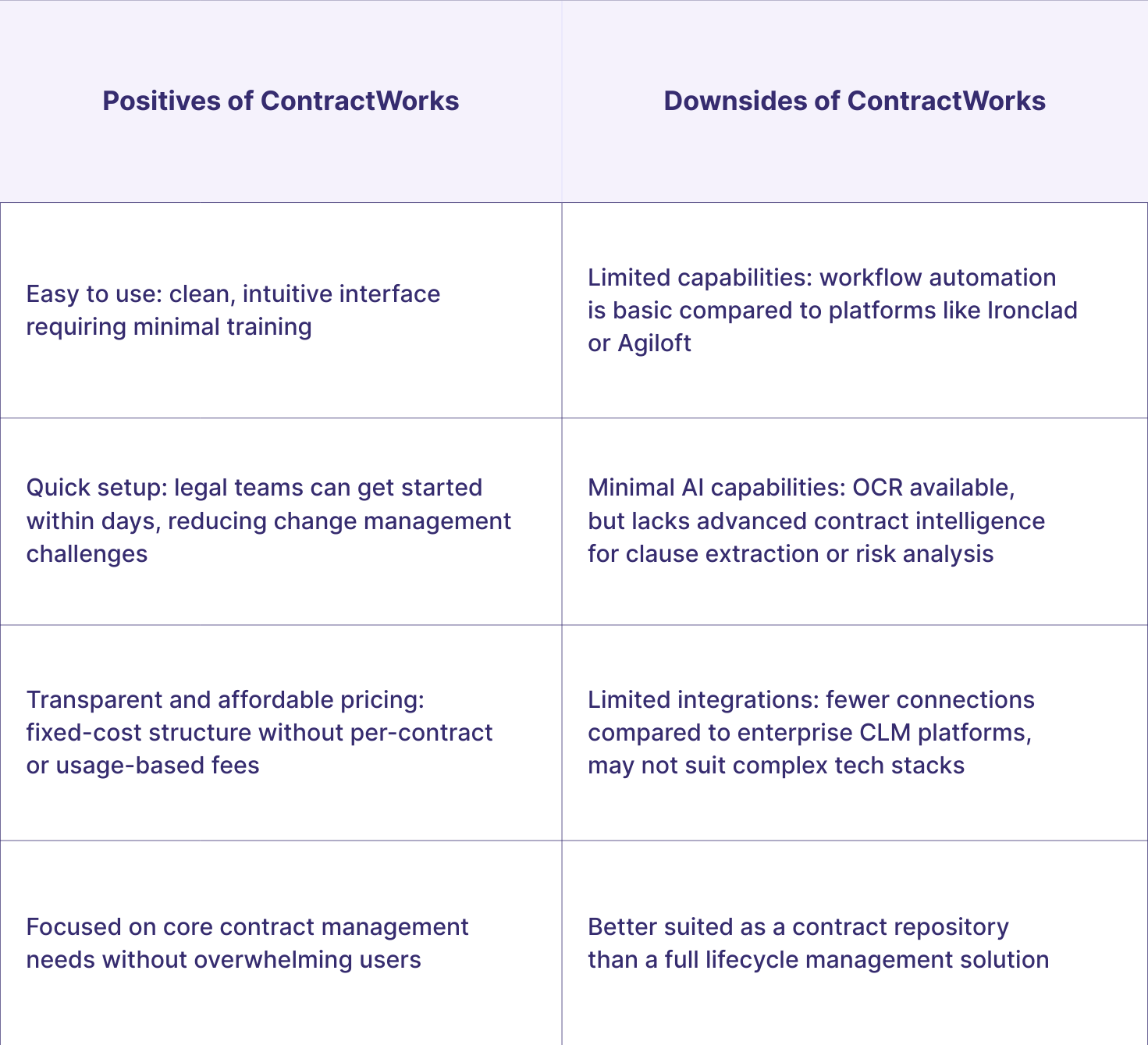
ContractWorks targets budget-conscious legal teams seeking basic contract repository and workflow capabilities without the complexity of an enterprise solution. If your primary goal is getting contracts out of file cabinets and email folders into a searchable system, ContractWorks offers a straightforward solution.
The platform emphasizes simplicity over sophistication. Upload contracts, tag them with relevant metadata, set reminders for important dates, and search when needed. The lean feature set means faster implementation and easier adoption.
Core Features
- Contract repository with full-text search
- Metadata tagging and custom fields
- Automated alerts and reminders
- Approval workflows
- Optical character recognition (OCR) for scanned documents
- User permissions and access control
Pros and Cons of ContractWorks
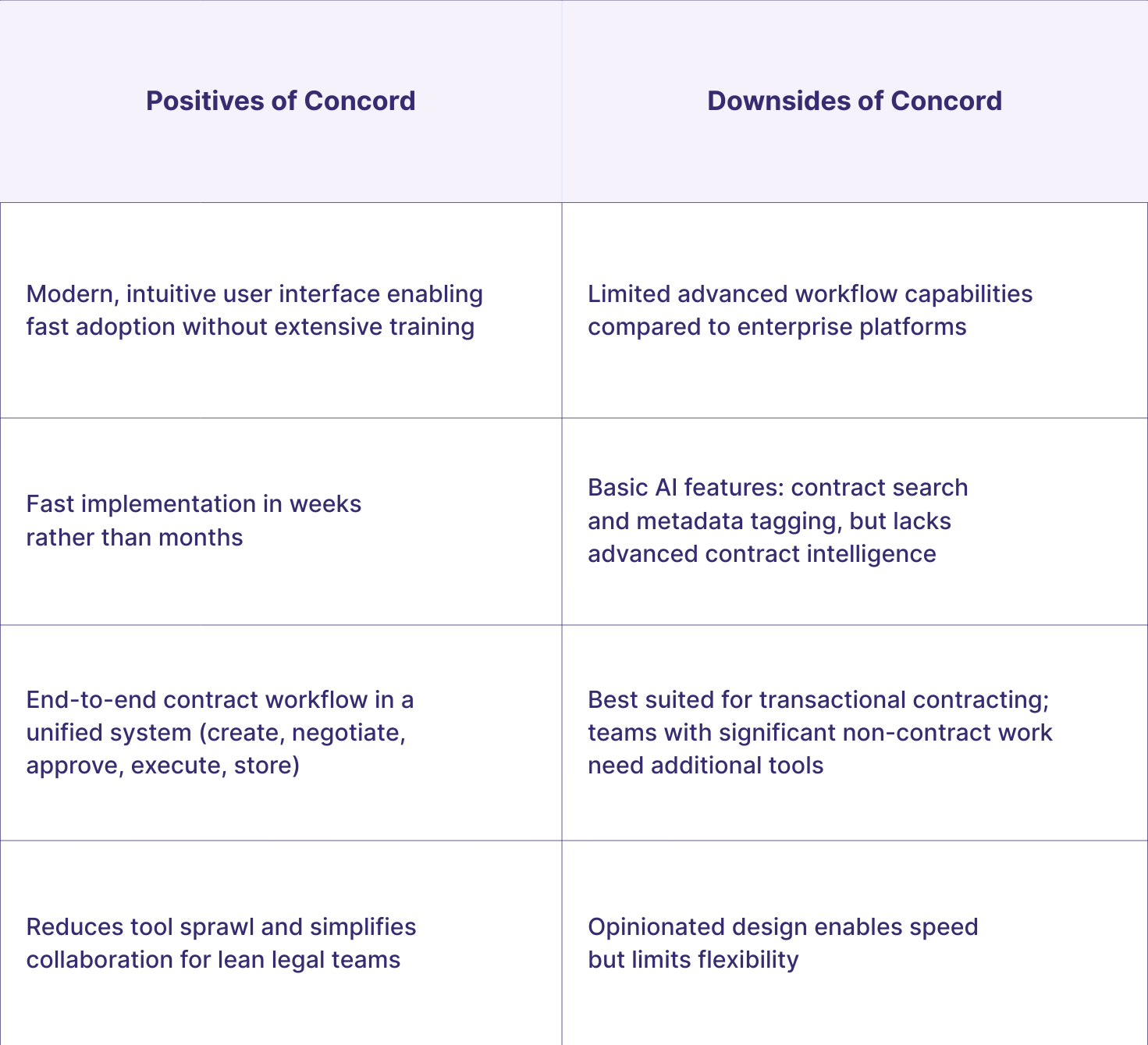
9. Concord: Best for Small Legal Teams
Concord positions itself as the CLM for growing companies and lean legal teams. The platform offers a modern user experience with core contract lifecycle features without enterprise-level complexity or pricing.
The focus on ease of use and fast time-to-value resonates with in-house counsel at small companies that have legal teams needing professional contract management but lack the resources for enterprise implementations.
Core Features
- Contract creation and version control
- Negotiation and commenting tools
- Approval workflows
- E-signature integration
- Contract repository with search
- Basic reporting and analytics
Pros and Cons of Concord
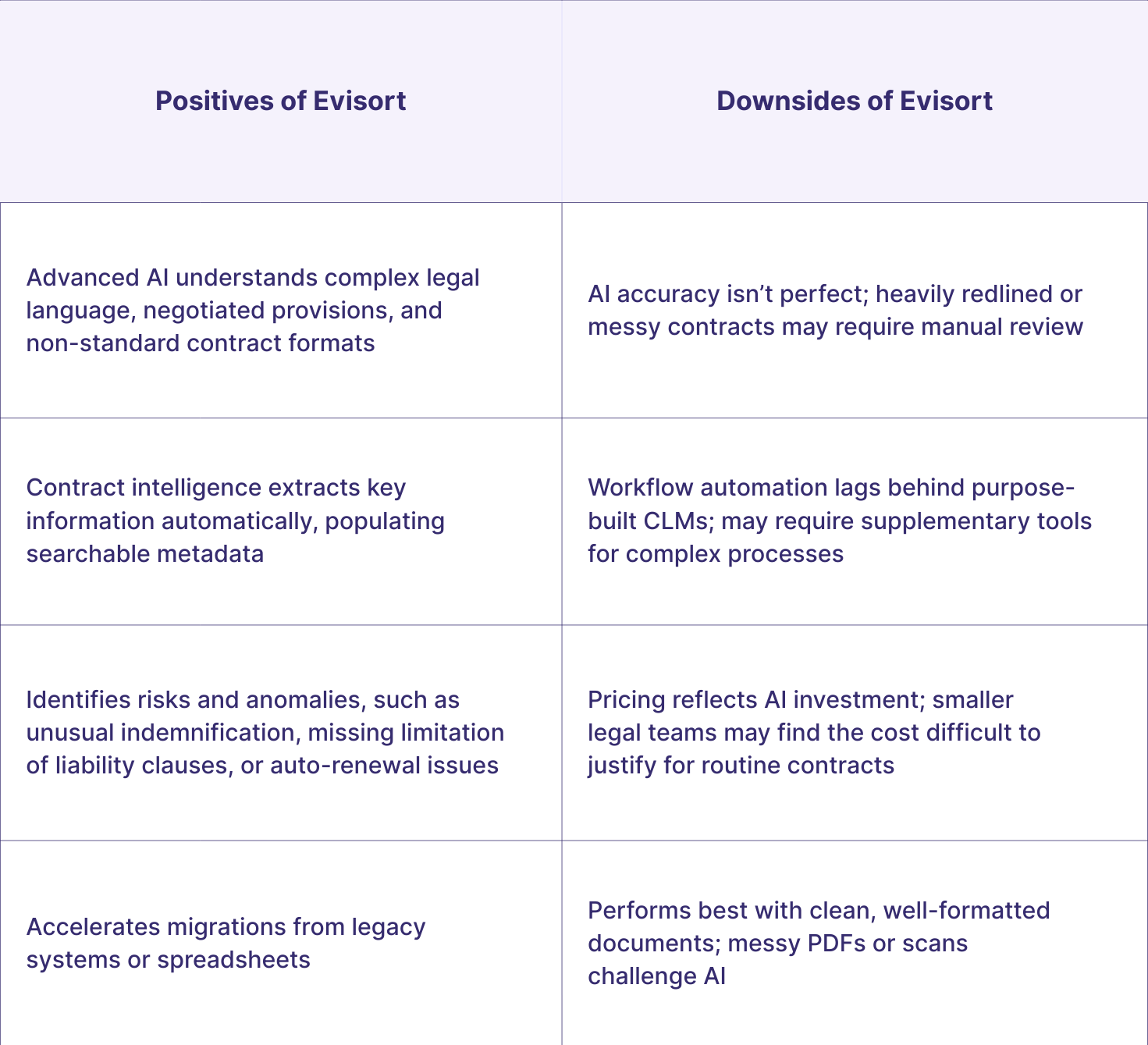
10. Evisort: Best AI Contract Intelligence
Evisort built its reputation on AI-powered contract analysis, training machine learning models specifically for legal documents. If contract intelligence (extracting data, identifying risks, analyzing obligations) is your primary need, Evisort warrants serious evaluation.
The platform's AI reads and understands contracts at a sophisticated level. Evisort identifies clauses, extracts key terms, flags unusual provisions, and creates searchable contract databases without manual data entry. This capability is particularly valuable during mergers and acquisitions (M&A) due diligence or contract migration projects.
Core Features
- Advanced AI contract analysis and data extraction
- Contract repository with intelligent search
- Workflow automation and approval routing
- Risk identification and scoring
- Obligation and renewal tracking
- Salesforce and Microsoft integration
Pros and Cons of Evisort
11. Juro: Best for Collaborative Contracting
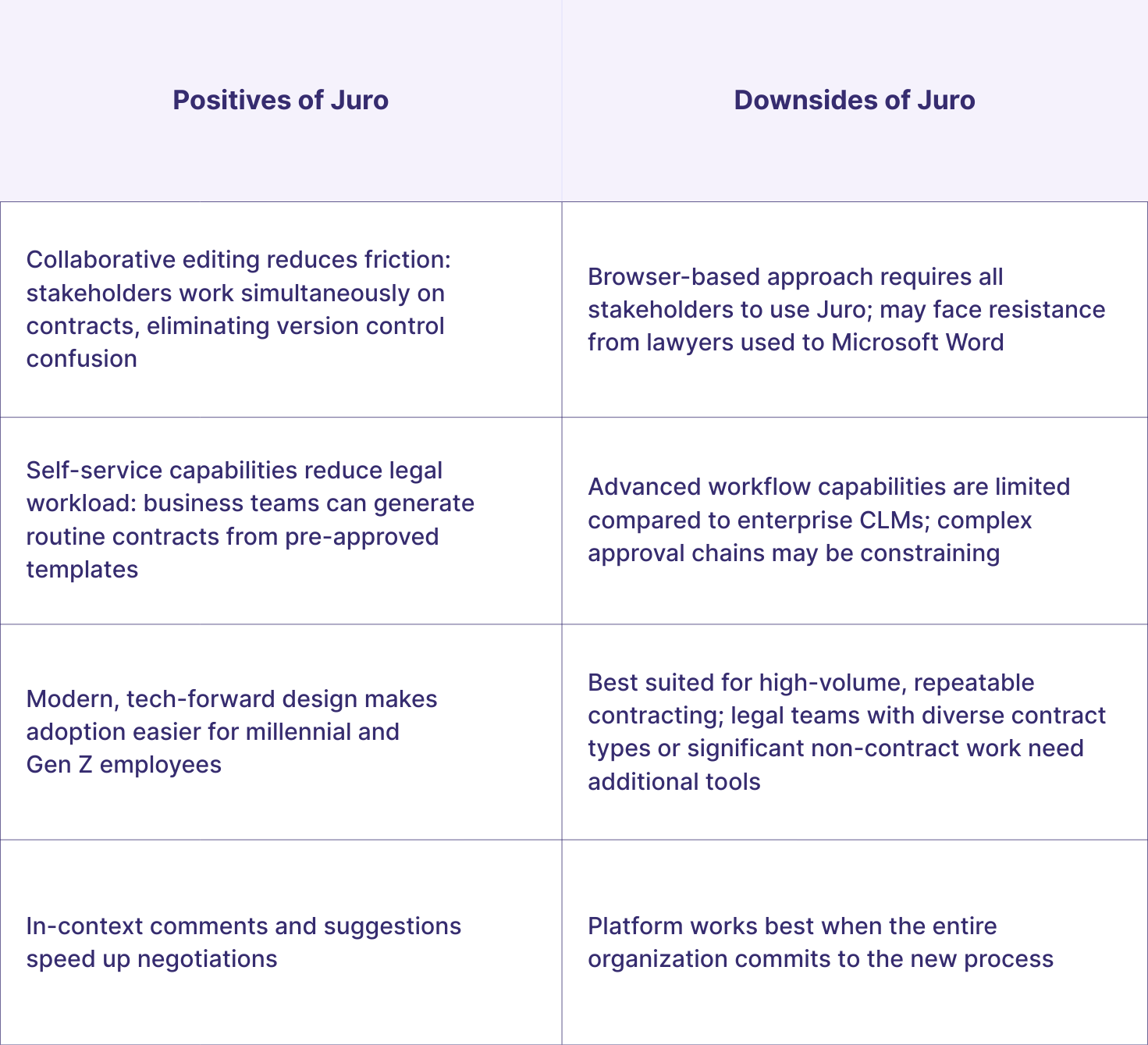
Juro reimagines contract creation as a collaborative, browser-based process. Instead of passing Word documents back and forth, stakeholders work together in a unified editor. For legal teams frustrated with email chains and version control nightmares, Juro is a practical solution.
The platform combines contract drafting, negotiation, approval, and execution in a single workflow. Business teams can generate contracts from legally approved templates, negotiate directly with counterparties on the platform, and route templates for signatures without leaving the browser.
Core Features
- Browser-based contract editor with real-time collaboration
- Self-service contract generation from templates
- In-platform negotiation and commenting
- Approval workflows and e-signature
- Contract repository with search
- Salesforce and CRM integrations
Pros and Cons of Juro
How to Choose the Best Legal Contract Management Software for You
Selecting legal technology requires an honest assessment of your specific situation. The "best" CLM platform depends entirely on your team's primary challenges, existing tech stack, and organizational readiness for change.
Here’s how to go about it.
Identify Your Core Pain Point
Legal teams leverage CLM software to address various challenges. Clarifying your primary need shapes the entire evaluation process. If your contracts are scattered across email and file shares, you need a reliable repository with robust search capabilities.
If Sales wants a faster turnaround, prioritize workflow automation. If you're overwhelmed by legal requests, you may need an intake platform rather than a traditional CLM.
Sometimes, an intake and triage problem can be disguised as a contracting problem. When 70% of requests don't result in contracts, traditional CLM tools can't help much. As such, consider whether your real challenge is contract execution or managing the flood of work hitting Legal.
Evaluate Implementation
Implementation timelines directly impact time-to-value. Enterprise CLM platforms with sophisticated features also entail complex implementations. Ask vendors for references from customers similar to your organization and inquire about the actual implementation duration, not best-case scenarios.
Consider your team's capacity for implementation.
- Do you have dedicated legal operations staff who can lead the configuration?
- Will you need external consultants?
- Can you commit your legal and business resources to a 12-month project, or do you need something to be up and running in weeks?
Even the most feature-rich platform adds little value if it never gets fully implemented. Smaller legal teams often achieve better outcomes with simpler tools they actually deploy than with enterprise platforms they configure partially.
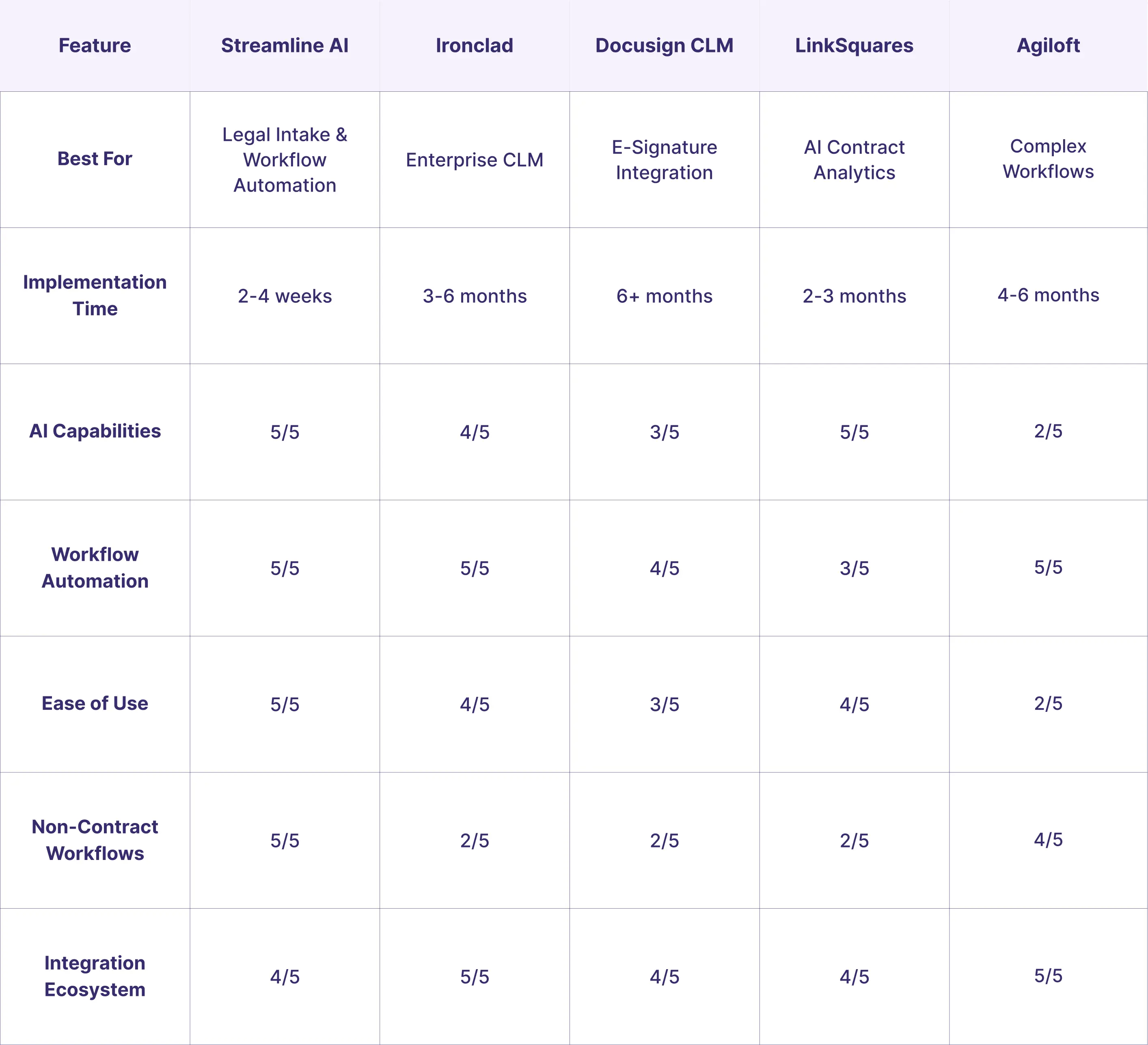
Purpose-built legal operations platforms, like Streamline AI, can be implemented in 2-4 weeks because they're designed for legal teams to configure without heavy IT involvement.
Assess Integration Requirements
No legal technology operates in isolation. Evaluate how CLM platforms connect with your existing tools: CRM systems, collaboration platforms, document storage, e-signature solutions, and SSO providers. Native integrations work better than API-based connections, which work better than manual processes.
Organizations heavily invested in specific ecosystems (e.g., Salesforce, Microsoft, Google Workspace) should prioritize platforms optimized for those environments. The friction of moving data between disconnected systems creates hidden operational costs that undermine CLM ROI.
If your legal team already uses specialized tools (such as a CLM for contract execution), consider whether you need a comprehensive CLM or targeted solutions to address specific gaps.
The Streamline AI + Ironclad combination exemplifies this approach: Streamline handles intake and matter management while Ironclad manages contract execution, creating a complete legal operations stack.
Consider AI Maturity and Accuracy
Evaluate AI capabilities by requesting evidence: demos with your actual contracts, accuracy metrics, and reference customer feedback about real-world performance.
AI contract analysis sounds impressive until extraction errors force manual review of every contract. The time saved by automation disappears if you have to validate and correct AI output. Request pilots or proof-of-concept engagements before committing to AI-powered platforms.
Remember that AI improves your existing processes but doesn't fix broken workflows. If your contracting process is chaotic before CLM implementation, AI will likely exacerbate the chaos. Address process issues before assuming technology will solve them.
Plan for Change Management
Technology adoption requires organizational change. The best CLM platform fails if business stakeholders refuse to use it. So, evaluate vendor support for training, documentation, and ongoing enablement.
Identify champions in business units who will promote adoption. Legal can't unilaterally force change on Sales, Procurement, or HR. Success requires partnership with stakeholders who view CLM as a tool that helps them work more effectively, rather than adding an administrative burden.
Consider starting small by implementing for one contract type or business unit, proving value, and then expanding to other areas. This approach builds momentum and demonstrates results before requiring organization-wide change.
Top Legal Contract Management Software: A Visual Comparison
Final Words
Choosing legal contract management software comes down to understanding the specific problem you're actually trying to solve. Traditional CLM platforms excel at contract execution, i.e., drafting, redlining, approving, and storing agreements.
However, the real challenge for many legal teams isn't contract management; it's the chaos that precedes it: the scattered requests, the triage decisions, and the cross-functional workflows that exist whether or not a contract is actually created.
If your legal team does more than pure contracting, you need broader legal operations management.
The best approach is to obtain a specialized solution for each problem rather than relying on an all-in-one platform. You can pair a true CLM, like Ironclad, with a legal intake and workflow platform like Streamline AI to create a comprehensive stack that manages everything from initial request through contract execution and storage.
The key is to accurately evaluate your specific situation. What causes the most frustration daily? Where do requests actually slow down? What would move the needle on your team's efficiency and your executive team's perception of Legal?
The answers to those questions should drive your technology decisions, not vendor promises or industry analyst reports.
Frequently Asked Questions
What Is the Difference Between CLM Software and Legal Intake Platforms?
CLM (Contract Lifecycle Management) software focuses on creating, negotiating, executing, and storing contracts. These platforms are well-suited for contract-specific workflows, such as template generation, redlining, approval chains, and signature collection.
Legal intake platforms, such as Streamline AI, manage a broader range of legal work; including, but not limited to, contracts. These platforms handle requests for legal advice, regulatory questions, employment matters, IP reviews, and compliance issues, providing triage, workflow automation, and analytics across all types of legal work.
How Long Does It Take to Implement Contract Management Software?
Implementation timelines vary depending on the platform's complexity, the organization's size, and the scope of the project. Purpose-built legal operations platforms, such as Streamline AI, can be implemented in 2-4 weeks because they're designed for legal teams to configure without requiring heavy IT involvement.
What Should I Look for in AI-Powered Contract Management Tools?
Look for platforms that demonstrate extraction accuracy with actual contracts during proof-of-concept pilots. Effective AI should be able to handle negotiated terms, non-standard formatting, and complex legal language without requiring extensive training for each new contract type.
The platform should provide confidence scores for extracted data, allowing you to identify which contracts need manual review. Ask vendors about accuracy metrics and false positive rates, not just feature lists.
Consider whether the AI genuinely reduces manual work or simply creates new tasks. The best AI-powered tools learn from your corrections and improve over time. Request references from customers about real-world AI performance, rather than curated success stories from vendor marketing materials.
Do I Need a Separate Legal Intake Tool If I Already Have CLM Software?
This depends on your legal team's work composition and pain points. If 80%+ of your legal work involves contracts and the remaining 20% is manageable through email or other tools, your CLM platform might suffice.
However, contracts typically account for only 30-50% of the work of most in-house legal teams. The majority consists of legal questions, regulatory guidance, employment matters, vendor reviews, IP advice, and compliance support, work that traditional CLM platforms often struggle to manage effectively.
Legal intake platforms, such as Streamline AI, provide structured workflows, automated triage, and comprehensive analytics for all types of legal work, not just contracts. Teams can achieve optimal results by pairing a specialized CLM (for contract execution) with a dedicated intake and workflow platform (for managing the broader range of legal requests).
This integrated approach provides complete visibility into legal operations, ensuring that each tool performs its function effectively.
.avif)