.avif)
Picture this: Your legal department closed 847 contracts last quarter. Leadership has no idea.
While Sales celebrates every deal and Marketing has dashboards for every funnel metric, Legal operates in a black box, manually routing requests through email, tracking contract status in spreadsheets, and spending much of their time on work that doesn't require a law degree.
The problem isn't that your legal team is slow; it's that legal work has been invisible, unstructured, and impossible to scale.
AI for legal teams isn't about automating lawyers out of existence, but rather surfacing the work that has always been there, eliminating the administrative friction that has obscured it, and finally providing your department with the operational infrastructure that every other business function has had for years.
From automating intake, accelerating contract reviews, and providing the metrics needed to demonstrate leadership on what your team actually accomplishes, the tools below not only save time but also make legal work measurable, scalable, and strategic.
Key Takeaways
- In-house legal teams that utilize AI reduce the time-to-close on legal requests by up to 50% while maintaining quality and control.
- The best AI for legal combines workflow automation, intelligent intake, and data analytics rather than just contract review capabilities.
- Legal-specific AI tools outperform generic solutions because they not only understand legal language but also comprehend the underlying legal processes.
- Teams achieve the fastest ROI when AI handles high-volume, repeatable tasks, such as NDA triage, intake routing, and status updates.
- Streamline AI is the highest-rated AI-powered intake and workflow platform built for in-house legal teams.
Best AI Tools for Legal Teams
- Streamline AI — Best overall AI for in-house legal workflow automation
- Ironclad — Best AI for contract lifecycle management at scale
- Spellbook — Best AI contract drafting and negotiation assistant
- Luminance — Best AI for due diligence and contract analysis
- Harvey — Best GPT-powered legal research and drafting assistant
- Lexion — Best AI contract management for lean legal teams
- Onit — Best enterprise AI for legal spend & e-billing management
- Casetext (CoCounsel) — Best AI-powered legal research platform
- LawVu — Best AI-powered contract and spend management platform
- Kira Systems — Best AI for M&A contract review and extraction
1. Streamline AI — Best Overall AI for In-House Legal Workflow Automation
Best for: In-house legal teams with 10+ lawyers handling high intake volumes and need intelligent automation across all legal request types, not just contracts.
Streamline AI is an AI-powered platform built for in-house legal intake, triage, and matter management. What sets Streamline AI apart is that it was created by a former Associate General Counsel at DoorDash who experienced firsthand the chaos of scaling a legal department during hypergrowth. That lived experience shows in every feature.
The platform treats your entire legal department as a business operation. Instead of forcing legal teams to use generic project management tools or complex enterprise software, Streamline AI provides purpose-built workflows that map to how legal teams actually work.
The AI reads unstructured email requests, automatically creates structured intake forms, routes matters to the right lawyers, and tracks everything in real-time. It alleviates the administrative friction that exhausts legal professionals, while providing leadership with the data needed to justify headcount and demonstrate impact.
Features
- AI Email Intake: Reads unstructured legal requests sent via email and automatically converts them into structured workflows. Business teams can stay in their preferred channels (email, Slack, Teams) while legal works in a centralized platform.
- Intelligent Request Routing: AI analyzes incoming requests and automatically assigns them to the right team member based on practice area, workload, and availability.
- Workflow Automation: Pre-built and customizable workflows for every request type: contracts, vendor reviews, NDAs, employment matters, IP questions, compliance requests, and more.
- Real-Time Analytics: Track request volume, cycle time, SLA compliance, and team capacity. Identify bottlenecks and demonstrate Legal's value with data.
- Knowledge Base: AI builds a searchable repository of past decisions, approved language, and FAQs.
- Seamless Integrations: Connects with CLMs, Slack, Teams, email, Salesforce, DocuSign, and more to meet teams where they work.
How to Get Started with Streamline AI
Book a demo today to see the platform in action. The team will guide you through your current intake process, identify areas for improvement, and demonstrate how Streamline AI integrates with your workflows. Implementation includes configuring forms, setting up automation rules, and training your team, all without requiring IT support.
2. Ironclad — Best AI for Contract Lifecycle Management at Scale
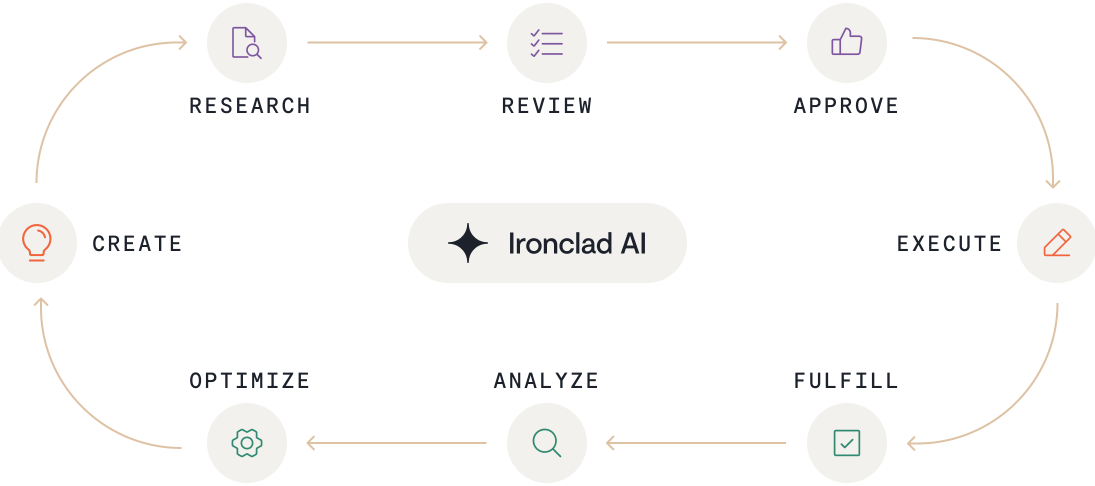
Best for: Enterprise legal teams managing thousands of contracts and needing CLM capabilities with AI-powered contract analysis.
Ironclad is one of the older contract lifecycle management platforms on the market. The AI capabilities focus heavily on contract creation, negotiation, and analytics. Ironclad's strength is handling contract volume at scale with features like Workflow Designer, template libraries, and approval routing.
The platform excels when your primary pain point is contract management specifically. If you're overwhelmed by vendor agreements, sales contracts, and procurement deals, Ironclad offers powerful tools for standardization and acceleration.
Features
- AI contract repository with automated metadata extraction
- Digital contracting workflows with e-signature integration
- Template management with dynamic clause libraries
- Contract analytics and reporting dashboards
- Third-party paper negotiation tools
- Workflow automation for approvals and routing
One area where Ironclad shines is post-signature contract management. The AI tracks renewal dates, extracts key terms, and flags obligations that need attention. For companies with thousands of active contracts, this prevents costly oversights.
However, Ironclad is purpose-built for contracts. If your legal team handles intake beyond contracts, employment questions, IP matters, compliance reviews, and litigation management, you'll still need another system for those workflows. Teams use Ironclad alongside matter management software to cover the full scope of legal operations.
3. Spellbook — Best AI Contract Drafting and Negotiation Assistant

Best for: In-house counsel who spend significant time drafting and negotiating contracts and want an AI copilot integrated into Microsoft Word.
Spellbook is an AI assistant that lives directly in Microsoft Word and analyzes contracts as you review them. Built on GPT-4, Spellbook can suggest language, identify missing clauses, spot risky terms, and even generate entire contract sections based on given instructions.
Spellbook’s main selling point is the user experience. You do not have to switch between systems or upload documents to another platform. The AI is already embedded in the tool you use for contract review.
Features
- AI contract review with risk identification
- Suggested clause language based on your playbooks
- Missing provision detection
- Negotiation guidance and strategy suggestions
- Language generation for specific contract terms
- Microsoft Word integration for seamless workflow
Spellbook is particularly useful during negotiation cycles. When reviewing a vendor's paper, Spellbook can suggest counterproposals, explain why certain terms are problematic, and generate alternative language to protect your company's interests.
However, the major downside is that Spellbook focuses exclusively on contract drafting and review. It won't help with intake, triage, matter tracking, or the operational side of legal workflow automation. This means you'll still need a system for managing who's working on what and tracking request status.
4. Luminance — Best AI for Due Diligence and Contract Analysis
Best for: Legal teams handling M&A due diligence, large-scale contract reviews, or complex document analysis projects.
Luminance built its reputation on AI-powered due diligence. The platform uses machine learning to analyze large volumes of contracts and legal documents, surfacing key terms, identifying anomalies, and flagging risks. It's ideal for M&A transactions that require reviewing hundreds or thousands of contracts quickly.
The AI learns from how lawyers on your team classify and prioritize documents. Over time, it gets better at understanding what matters for your specific use cases.
Features
- AI-powered document review and analysis
- Contract comparison and deviation detection
- Due diligence automation for M&A transactions
- Clause extraction and metadata tagging
- Anomaly detection for unusual terms
- Contract repository with advanced search
Luminance excels when you have a high-stakes project that requires reviewing massive document sets. The AI accelerates due diligence timelines and reduces the risk of missing critical provisions that are often buried in lengthy agreements.
However, Luminance is primarily a contract analysis tool, not a workflow management platform. It won't help with daily intake, request routing, or the operational challenges most in-house legal teams face. It's a powerful tool for specific situations rather than a system for running Legal like a business.
5. Harvey — Best GPT-Powered Legal Research and Drafting Assistant
Best for: In-house counsel who need AI assistance with legal research, memo drafting, and complex legal analysis.
Harvey is an AI assistant built for legal professionals, powered by a customized version of GPT-4. Unlike generic AI tools, Harvey is trained on data specific to the legal field and understands legal reasoning, citations, and argumentation.
The tool functions like a competent legal associate. You can ask Harvey to research specific legal questions, draft memos, summarize case law, or analyze documents. The AI provides sources and reasoning for its conclusions, making it easier to verify accuracy.
Features
- Legal research with case law citations
- Memo and brief drafting assistance
- Document summarization and analysis
- Contract review with issue spotting
- Legal question answering with reasoning
- Integration with firm knowledge bases
Harvey suits teams that don't have extensive research support. When you need to understand the legal context around a new regulation or analyze a complex contractual issue, Harvey can produce a solid first draft in minutes rather than hours.
The caveat is that Harvey is a drafting and research tool, not an operational platform. It won't manage your intake process, track matters, or give you visibility into team workload. You'll still need legal project management software to run your department effectively.
6. Lexion — Best AI Contract Management for Lean Legal Teams
Best for: Small to mid-size legal teams (3-15 lawyers) who need straightforward contract management without much complexity.
Lexion focuses on making contract management simple and accessible. The AI automatically extracts key terms from contracts, tracks important dates, and organizes agreements in a searchable repository. The interface is clean and intuitive, designed for teams that want functionality without much implementation hurdles.
Lexion’s emphasis on user experience and speed sets it apart. The platform aims to be the anti-enterprise software; quick to set up, easy to use, and focused on solving the most common contract pain points.
Features
- AI contract repository with automatic metadata extraction
- Key date tracking and renewal alerts
- Contract request and approval workflows
- Template management for standard agreements
- Integration with Microsoft Word and DocuSign
- Reporting on contract metrics and trends
Lexion suffices when your primary need is organizing and tracking contracts. If you're still managing contracts in shared drives or email, Lexion provides immediate value. The AI handles the tedious task of reading contracts and extracting key information.
The trade-off is that Lexion is primarily a CLM tool. For broader legal intake and workflow automation, you'll need additional tools or manual processes.
7. Onit — Best Enterprise AI for Legal Spend & E-Billing Management
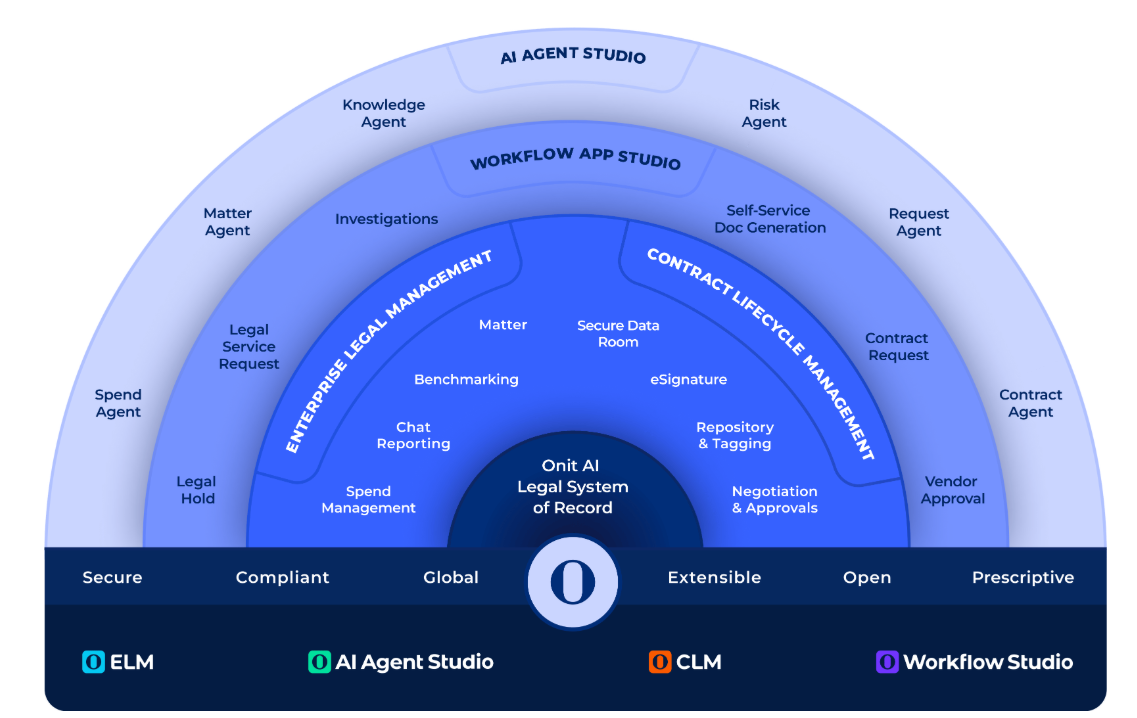
Best for: Large legal departments at Fortune 500 companies that need sophisticated outside counsel management, e-billing, and legal spend analytics with AI-powered cost predictions.
Onit is an enterprise legal operations platform built for complex organizations, but its clearest differentiator is legal spend management: centralizing invoice handling, budget tracking, and leadership visibility into where legal dollars go.
Its AI capabilities are often positioned around predicting and optimizing legal spend, making it a fit when your pain point is cost governance and reporting, not just moving requests through Legal.
Features
- E-billing and invoice management with automated coding and approval workflows
- Legal spend analytics and budget forecasting with AI-powered predictions
- Outside counsel performance management and panel optimization
- Matter management and tracking (primarily for billed matters)
- Integration with ERP and finance systems for budget alignment
- Business intelligence dashboards for C-suite reporting
Onit’s biggest advantage is consolidation. You can run a wide slice of legal ops in one system, from intake through final billing, which is valuable for teams that prioritize standardization and enterprise governance.
That said, platforms built for large-scale deployments often require a more involved rollout. Expect time spent on configuration (workflows, permissions, billing rules), data migration, and change management across Legal Ops and Finance, especially if you are implementing spend management and ERP or finance integrations.
In many organizations, you will also want a dedicated internal owner, and often an admin, to maintain the system over time, keep reporting clean, and make sure the platform continues to match how the business actually works.
8. Casetext (CoCounsel) — Best AI-Powered Legal Research Platform

Best for: In-house counsel who regularly need legal research, case law analyses, and litigation support.
Casetext's CoCounsel is an AI legal assistant that combines legal research capabilities with document review and analysis. Built on GPT-4, CoCounsel can research legal issues, summarize depositions, review documents for relevance, and draft legal documents with precision.
The platform works well for litigation support and regulatory research. When you want to know how courts have interpreted a specific provision or research compliance requirements, CoCounsel provides a comprehensive analysis with citations.
Features
- AI legal research with case law analysis
- Document review and summarization
- Deposition and transcript analysis
- Contract review and clause identification
- Legal memo drafting assistance
- Regulatory research and compliance guidance
CoCounsel is valuable when legal research is a frequent need. The AI can tackle questions that would take hours of traditional research and produce results in minutes. For in-house teams without dedicated research support, this is significant.
However, CoCounsel is a research and analysis tool, not an operational platform. It won't help you manage intake, track matters, or coordinate work across your team. Research is one component of legal operations, but most teams need broader legal automation to address their efficiency challenges.
9. LawVu — Best AI Matter Management for Collaborative Legal Teams
Best for: In-house legal teams who need contract lifecycle management tightly integrated with legal spend tracking and outside counsel management.
LawVu is a legal operations platform that combines AI-powered contract lifecycle management with comprehensive spend management capabilities in a unified system. While it supports broader legal work management, the platform's strength lies in connecting contract workflows directly to financial tracking, enabling legal teams to manage both the contractual relationships and the associated costs in one place.
The platform includes features for tracking matters, managing documents, automating workflows, and reporting on legal metrics. LawVu aims to be the central hub for all legal work.
Features
- AI-powered contract lifecycle management with automated workflows
- E-billing and invoice processing for outside counsel
- Legal spend tracking and budget management
- Vendor and outside counsel management
- Contract repository with AI-driven metadata extraction
- Financial reporting and spend analytics dashboards
LawVu can be a strong option when you want a more centralized system for contract work, plus better reporting for legal operations. Keep in mind it’s still a full legal ops platform, so rollout typically requires configuration, training, and an ongoing admin owner to keep the system running smoothly.
10. Kira Systems — Best AI for M&A Contract Review and Extraction
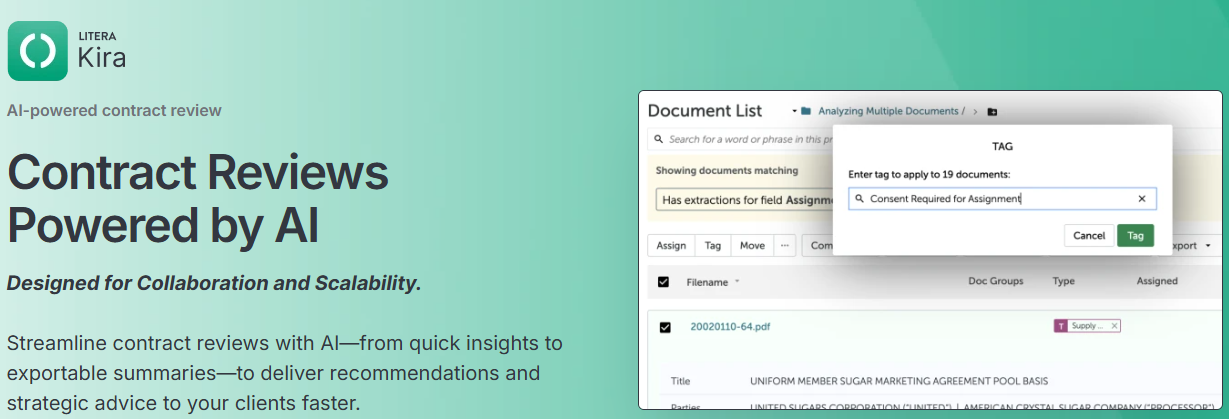
Best for: Legal teams focused on M&A due diligence who need precise contract data extraction at scale.
Kira Systems specializes in AI-powered contract review and analysis, particularly for mergers and acquisitions (M&A) transactions. The platform can identify and extract over 1,000 different provision types from contracts, leases, and other legal documents. Kira's machine learning continuously improves accuracy as it processes more documents.
The tool is particularly suitable for projects that demand due diligence, where you need to quickly understand the contents of a target company's contracts. Kira can review hundreds of agreements and produce detailed reports on key terms, risks, and opportunities.
Features
- AI contract review and clause identification
- Provision extraction across 1000+ clause types
- Due diligence reporting and analytics
- Contract comparison and deviation analysis
- Machine learning that improves with use
- Integration with data rooms and document management
Kira is purpose-built for contract analysis at scale. When evaluating an acquisition and want to understand exposure across the target's entire contract portfolio, Kira accelerates that process dramatically.
The limitation is specificity. Kira is exceptional at what it does, but that's a narrow use case. Most in-house legal teams don't spend the majority of their time on M&A due diligence. For day-to-day legal operations (e.g., intake, triage, matter management, workflow automation), Kira falls short.
How to Choose the Best AI for Legal Teams
Selecting AI for your legal department isn't about finding the most advanced technology. It's about matching capabilities to your actual pain points. Teams that succeed with legal AI start by identifying their highest-friction workflows and choosing tools that eliminate that friction.
Here is how to go about it:
Define Your Primary Use Case
Are you drowning in intake volume? Struggling with contract backlogs? Lacking visibility into what your team is working on? Different AI tools solve different problems. Streamline AI handles intake and workflow automation. Ironclad focuses on contract lifecycle management. Harvey provides research assistance.
The teams that see the fastest ROI choose AI that addresses their most painful operational challenge first. If your GC can't answer "how many requests did we handle last quarter?" then you need workflow and analytics AI before you need contract review AI.
Consider the Full Scope of Legal Work
In-house legal teams handle employment questions, vendor reviews, IP matters, compliance guidance, litigation management, corporate governance, and dozens of other request types.
The best AI for your team should handle the full breadth of legal work, not just one category. That's why platforms like Streamline AI, which automate all intake types, often deliver more value than specialized contract tools.
Evaluate Implementation Reality
AI that takes six months to implement and requires IT support for every workflow change looks great in demos, but often fails in practice. Legal teams often lack spare IT resources, and waiting six months for implementation is too long.
The best AI for Legal gets you to value quickly. Streamline AI typically goes live in weeks. Teams can process real requests through automated workflows within days of implementation. Speed matters when your team is already struggling.
Prioritize User Adoption
The most sophisticated AI is worthless if your team can't use it. Look for tools with intuitive interfaces that match how legal teams actually work. AI that requires extensive training or forces workflows that don't align with legal processes will likely face resistance.
This is where legal-specific AI has an advantage over generic tools. Software built for in-house legal teams understands the difference between a contract review request and an employment question.
It recognizes that NDAs require distinct workflows from vendor agreements. That built-in understanding means your team spends less time configuring and more time working.
Assess Data and Analytics Capabilities
One of the biggest advantages of AI for legal is the data it generates. The right platform displays request volume by department, average time-to-close by matter type, SLA performance, and identifies where bottlenecks exist. This data transforms how you advocate for resources and demonstrate value.
When evaluating AI tools, consider their reporting capabilities. Can you easily show your CFO how many requests your team handles? Can you prove that delays happen outside Legal? Can you identify which business units generate the most work? Tools that surface these insights help you run Legal like a business.
The Best AI for Legal Teams: A Visual Comparison
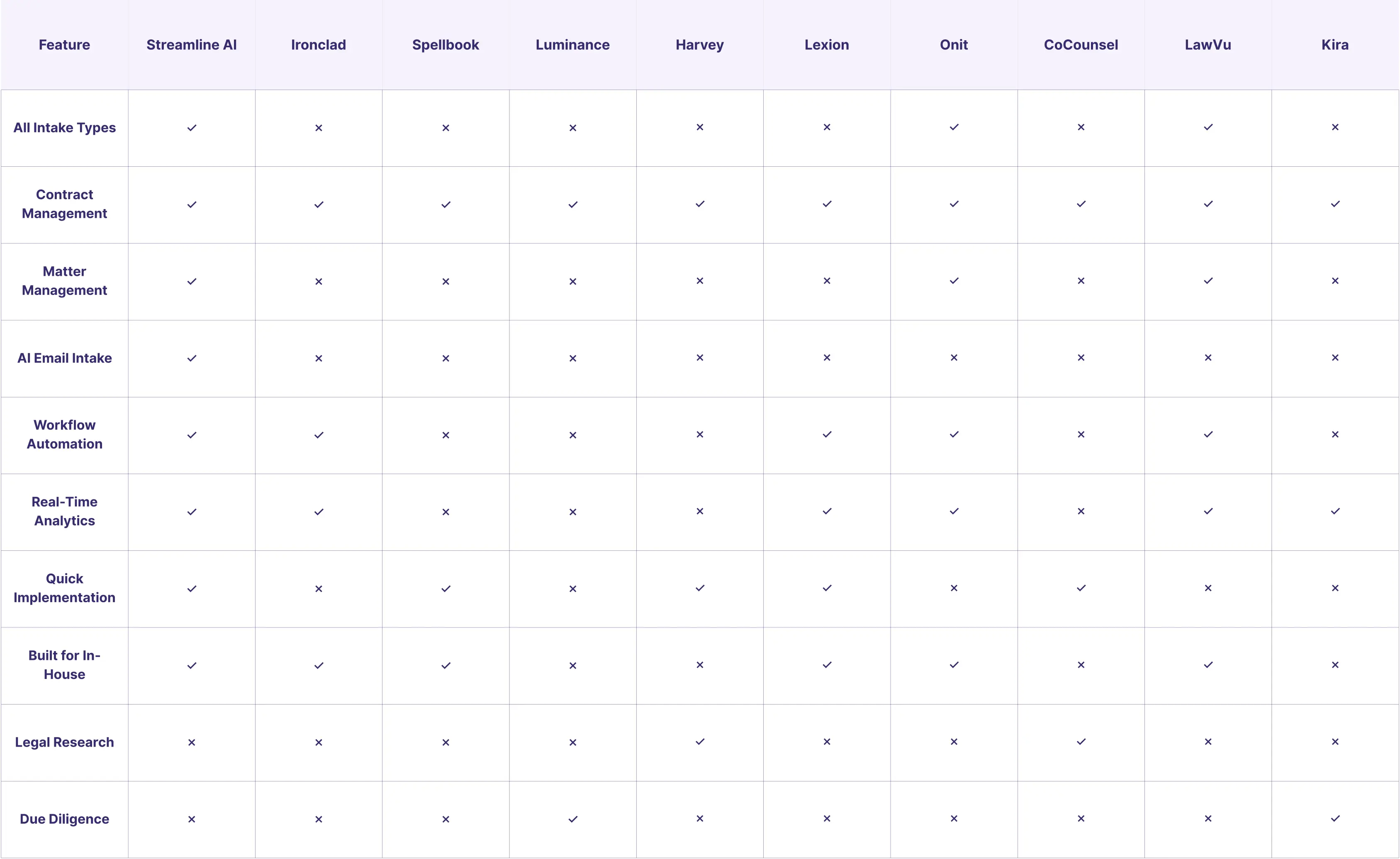
Getting Started with Streamline AI
Streamline AI is purpose-built for in-house legal teams that need to modernize operations, reduce workload chaos, and demonstrate strategic value. The platform combines AI-powered intake, workflow automation, and real-time analytics in a system that can be set up in weeks.
Here's what makes Streamline different: it was created by someone who lived your challenges. Kathy Zhu, founder and CEO of Streamline, served as Associate General Counsel at DoorDash during the company's most explosive growth period.
She experienced firsthand what happens when a legal team goes from manageable request volume to complete chaos. Streamline exists because generic tools like Jira weren't built for legal operations, and enterprise software was too slow and complex to provide relief.
Streamline AI reduces time-to-close on legal requests by up to 50% while improving team morale and business satisfaction. The platform consistently earns customer satisfaction scores of 4.8 or higher.
Book a demo to see how Streamline AI transforms legal operations for teams like yours.
Final Words
The right AI for your legal team depends on your specific operational challenges. If your primary challenge is the same one most in-house legal teams face—too many requests, not enough lawyers, and no visibility into what's happening—then you need AI that handles the full scope of legal operations.
You need an intelligent intake that works across all request types, workflow automation that gives business teams visibility, and analytics that prove Legal's value and identify real bottlenecks.
That's where Streamline AI excels. It's a platform designed to serve as the operating system for your entire legal department.
Frequently Asked Questions
What is AI for Legal Teams?
AI for legal teams refers to artificial intelligence software that automates legal workflows, accelerates contract review, manages intake and triage, provides legal research capabilities, and generates analytics on legal operations. The best AI for legal combines multiple capabilities rather than focusing on just one narrow use case.
How can In-House Legal Teams Use AI Effectively?
In-house legal teams can leverage AI more effectively by focusing on high-volume, repeatable tasks first. AI can handle intake routing, contract triage, status updates, deadline tracking, and extracting insights from legal data. Start with operational AI to reduce administrative friction before adding specialized capabilities like contract drafting or legal research.
Will AI Replace In-House Lawyers?
AI will not replace in-house lawyers, but it will fundamentally change how legal departments operate. AI handles repetitive, administrative work, giving lawyers more time for strategic analysis, complex negotiations, and business partnerships. In-house counsel who use AI effectively become more valuable because they can focus on judgment-intensive work that requires legal expertise.
What's the Difference Between AI for Contracts and AI for Legal Operations?
AI for contracts focuses specifically on reviewing, drafting, and analyzing contractual agreements. AI for legal operations addresses the broader operational challenges legal teams face, like intake management, workflow automation, matter tracking, resource allocation, and performance analytics. Most in-house teams need both, but operational AI typically delivers faster ROI because it addresses the daily friction that affects all legal work, not just contracts.
.avif)