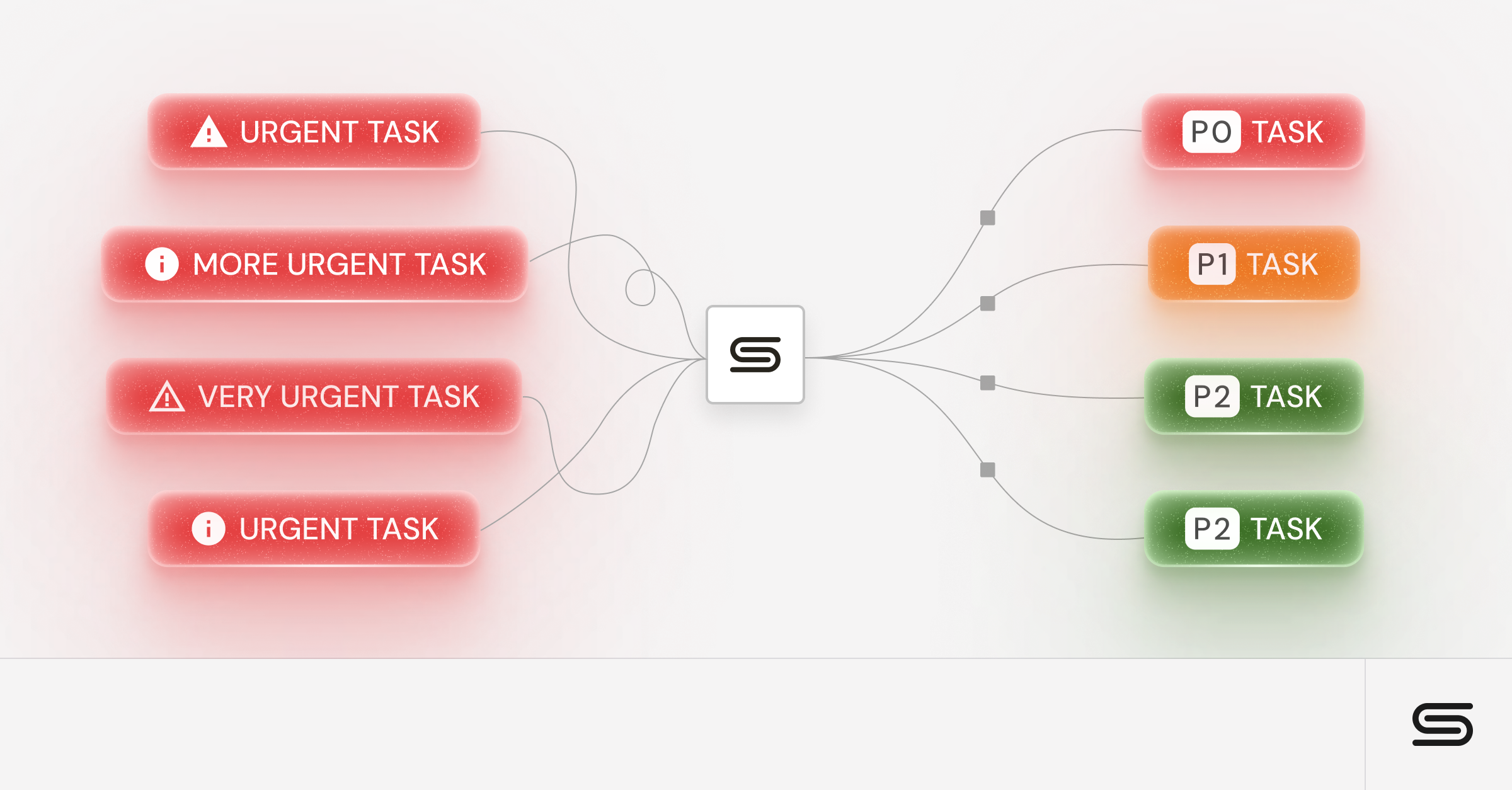
Every request in the legal intake queue shouldn't be marked "urgent." Yet, for most in-house legal departments, this is the daily reality. When every commercial contract is labeled a high priority, every marketing review is deemed time-sensitive, and every internal stakeholder insists their issue cannot wait, legal teams are left trying to manage an impossible level of demand.
The primary issue for modern legal teams is rarely just the sheer volume of work—it is the absence of a shared, transparent framework for deciding what truly matters, what can wait, and who owns those critical tradeoffs. Without a structured triage system, legal departments get stuck in a perpetual cycle of reactive firefighting. This leads to internal friction, delayed business cycles, and legal team burnout.
In a recent webinar hosted by Streamline AI, Ilan Horstein (VP, Deputy General Counsel at 8x8) and Kathy Zhu (Co-Founder & CEO of Streamline AI) shared a blueprint for how high-performing legal teams can transition from chaotic triage to a socialized, scalable prioritization model.
Here is how you can take the "urgency conversation" out of your legal team’s inbox and build a system that supports business growth without burying your counsel.
Key Takeaways
- When every request is marked urgent, legal teams are left managing an impossible level of demand without a shared way to decide what matters.
- The core problem is the absence of a transparent system for deciding what is truly urgent and who owns those tradeoffs.
- A standardized priority tiering system, agreed on by legal and business units, introduces objective consistency into the workflow.
- Socializing the system across departments and aligning it with business metrics drives adoption and shifts the burden of proving urgency to requesters.
- Ready to take the urgency debate out of your inbox? See how Streamline AI supports prioritization and book a demo.
1. The Core Problem: Why the "Loudest Voice" Wins
In a default business environment, requests are often triaged by volume or proximity: whichever stakeholder follows up the most, or holds the highest title, gets their work done first.
This ad-hoc approach creates three major operational vulnerabilities:
- The Invisible Backlog: Without a centralized intake channel, work is scattered across emails, Slack messages, and hallway conversations. Legal leaders cannot accurately evaluate total department capacity.
- The "Arbitrator" Trap: In-house lawyers are forced to act as arbiters between conflicting business priorities (e.g., deciding whether a Sales agreement is more urgent than an HR compliance matter). This is a business decision, not a legal one.
- Misaligned Impact: High-risk, high-leverage strategic initiatives get delayed because lawyers are buried under low-risk, routine administrative requests.
To solve this, legal departments must shift the burden of proving urgency back onto the business stakeholders so they can focus on the work that matters most.
2. Implementing the P0–P4 Legal Prioritization Matrix
A scalable framework requires a standardized tiering system that both the legal team and business units agree on. Horstein and Zhu recommend a structured P0 to P4 priority model to introduce objective consistency into the workflow:
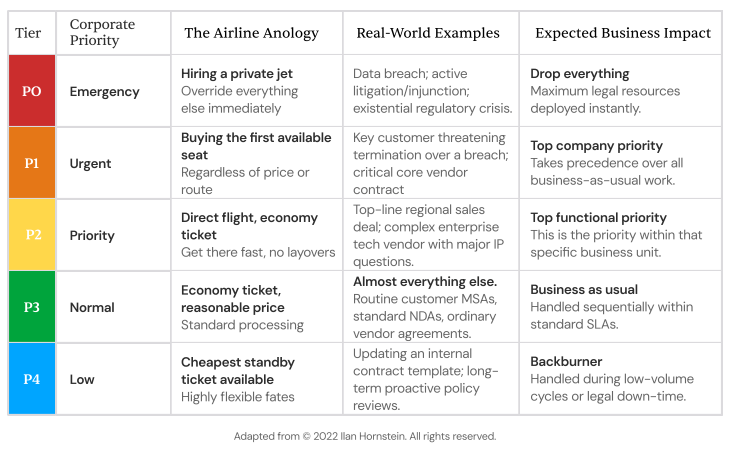
By standardizing these definitions, your legal team no longer has to guess what matters. If a stakeholder submits a ticket as a P1, it must map directly to the corporate criteria established for high priority—not just their personal deadline.
3. Socializing the Framework Across Departments
A framework is only as good as its adoption. You cannot build a triage system in a vacuum and expect other departments to respect it. To make the framework scalable, legal teams must actively socialize these rules with cross-functional leadership in Sales, Marketing, Product, and HR.
Align with Business Metrics
When presenting the framework to executive leadership, frame it in terms of business velocity. For example, explain to the VP of Sales: "By categorizing routine agreements as P2 or P3, we ensure our senior commercial counsel has their calendar cleared to clear blockages on your largest P1 deals at the end of the quarter."
Automate the Gatekeeping
Do not rely on stakeholders to memorize the P0–P4 definitions. Use a structured intake tool to ensure the framework is followed. When a user submits a request, the intake form should ask objective questions that automatically categorize the request by financial impact, contract type, or regulatory risk.
4. Shifting the Burden of Urgency
One of the most powerful insights from the Streamline AI webinar is the concept of socializing accountability. If a business stakeholder insists that a routine matter must skip the queue, the legal team should not be the bad guy saying no. Instead, the framework should require the stakeholder to justify that escalation to their own department head.
"If everything is urgent, then nothing is. Shifting the burden of prioritization means asking the business to decide which of their own projects they want to deprioritize to make room for a new emergency."
When a Sales Director has to explain to the VP of Sales why a smaller deal needs to bump a larger, strategic deal out of the legal queue, the number of artificial "emergencies" drops dramatically.
5. Protecting Capacity with Legal Tech and Automation
Ultimately, a manual framework will buckle under the weight of scaling corporate volume. To protect your department's capacity, you need a dedicated "mission control" system.
Modern legal operations technology allows departments to:
- Centralize All Intake: Eliminate email and Slack requests by routing everything through a single, searchable portal.
- Automate Triage: Automatically route specific contract types to the appropriate designated legal resource based on the tiering matrix.
- Surface Operational Metrics: Track average turnaround times, departmental volume, and bottleneck areas.
With data in hand, General Counsel can shift from defending their team's speed to proving their strategic value—and accurately justifying the need for additional headcount when capacity limits are reached.
Ready to Optimize Your Legal Workflow?
Stop managing demand in a reactive vacuum. By establishing a shared priority framework, you protect your team's mental bandwidth, build healthier relationships with business partners, and ensure legal is viewed as a driver of growth rather than a blocker.
Download a full copy of the prioritization framework discussed by Ilan Horstein and Kathy Zhu, or book a demo to see how modern intake automation can streamline your operations.
Frequently Asked Questions
Why Do Legal Teams Need A Prioritization System?
Legal teams need a prioritization system because, without one, every request gets labeled urgent and work is triaged by whoever follows up most or holds the highest title. A shared, transparent system lets teams decide objectively what truly matters, what can wait, and who owns those tradeoffs, reducing reactive firefighting.
What Is A Legal Priority Matrix?
A legal priority matrix is a standardized tiering system, often ranging from P0 to P4, that both legal and business units agree on. Each tier maps to defined corporate criteria for urgency and impact. This gives the legal team an objective, consistent way to rank requests rather than guessing what matters most.
How Do You Get Departments To Follow A Legal Priority System?
A system only works if it is adopted, so legal must actively socialize the rules with cross-functional leadership in sales, marketing, product, and HR. Aligning priority definitions with business metrics and building the system collaboratively, rather than in isolation, helps other departments understand and respect it.
What Problems Arise Without A Prioritization System?
Without a system, work scatters across emails, messages, and hallway conversations, creating an invisible backlog that hides true capacity. Lawyers are forced to arbitrate between conflicting business priorities, which is a business decision rather than a legal one, and high-impact strategic work gets delayed beneath routine requests.
Who Should Decide The Priority Of A Legal Request?
The priority of a request should be determined by shared criteria agreed on between legal and the business, not by the loudest stakeholder or highest title. Shifting the burden of proving urgency onto business stakeholders, against a standardized system, lets legal focus on the work that genuinely matters most.



.avif)